Backyard Putting Green Charlotte vs Multi-Use Court
Opening answer (BLUF)
Choose the surface that matches the game you actually want to host. A dedicated backyard putting green is the right call when golf is the destination: true roll, cups, and contours that feel like a designed garden room. A multi-use turf court is the better family recreation pad when soccer, catch, and casual putting share one rectangle. Both ideas are in real demand. In 2025, 48.1 million Americans age 6 and older played golf on a course or away from one, and 24.3 million Americans played pickleball. [1][2] On a typical Charlotte lot, one of those destinations can look finished and inviting. Trying to force both at full size usually asks more space than the yard can give.
Two destinations, two different jobs
A putting green and a multi-use turf court can both be green, both can be custom, and both can sit beside a patio. They are not the same product.
A dedicated green is built for a golf ball. The pile is short and dense so the ball rolls instead of hopping. The surface is shaped with gentle breaks, a fringe that gathers missed putts, and cups you can move so the same ten feet never feels stale. The United States Golf Association has treated putting surfaces as a specialized craft since 1960, when it first published recommendations for a method of putting green construction. Those recommendations still describe a layered, drained profile: a firm subgrade that follows the finished slope, drain lines with a continuous fall of at least 0.5 percent and laterals spaced no more than 15 feet apart, a gravel layer at least 4 inches deep, and a 12-inch rootzone (plus or minus 1 inch) on a living green. [3] A backyard synthetic green is not a golf-course agronomy project. The lesson still applies. The play you feel under a putter comes from shaping, drainage, and a surface specified for roll.
A multi-use turf court is built for feet, not for a three-foot slider. The fibers are taller. The system often includes a shock pad or a deeper infill so running, cutting, and falling feel cushioned. The rectangle is flatter so a soccer ball or a pickleball can bounce with some honesty. That surface can host a putting cup as a bonus. It will not roll like a green that was designed only for putting.
When we walk a Charlotte property, we start with that distinction. Outdoor Living is not a leftover strip of lawn. It is a room. The question is which room you want.
When a dedicated putting green is the better play
Pick the green when golf is the reason you walk outside after dinner.
That is a larger group than it used to be. The National Golf Foundation reports that 48.1 million Americans played in 2025, including 29.1 million who played on a course and 19 million who played only off-course at ranges, simulators, and entertainment venues. Junior on-course play reached about 4 million, the most since 2004. [1] A backyard putting green gives those players a daily short-game station without a drive to the club.
Speed and feel are the point. In the 1970s the USGA released the Stimpmeter so superintendents could measure green speed in a repeatable way. The newer GS3 tool still reports that speed in feet and inches, and it also records firmness, smoothness, and trueness. The USGA is clear that faster has often been misconstrued as meaning better, and that championship numbers are the wrong target for everyday play. [4] On a home green, we aim for a roll that is consistent, enjoyable, and honest. You should be able to practice pace and break, then take that feel to a Carolina course.
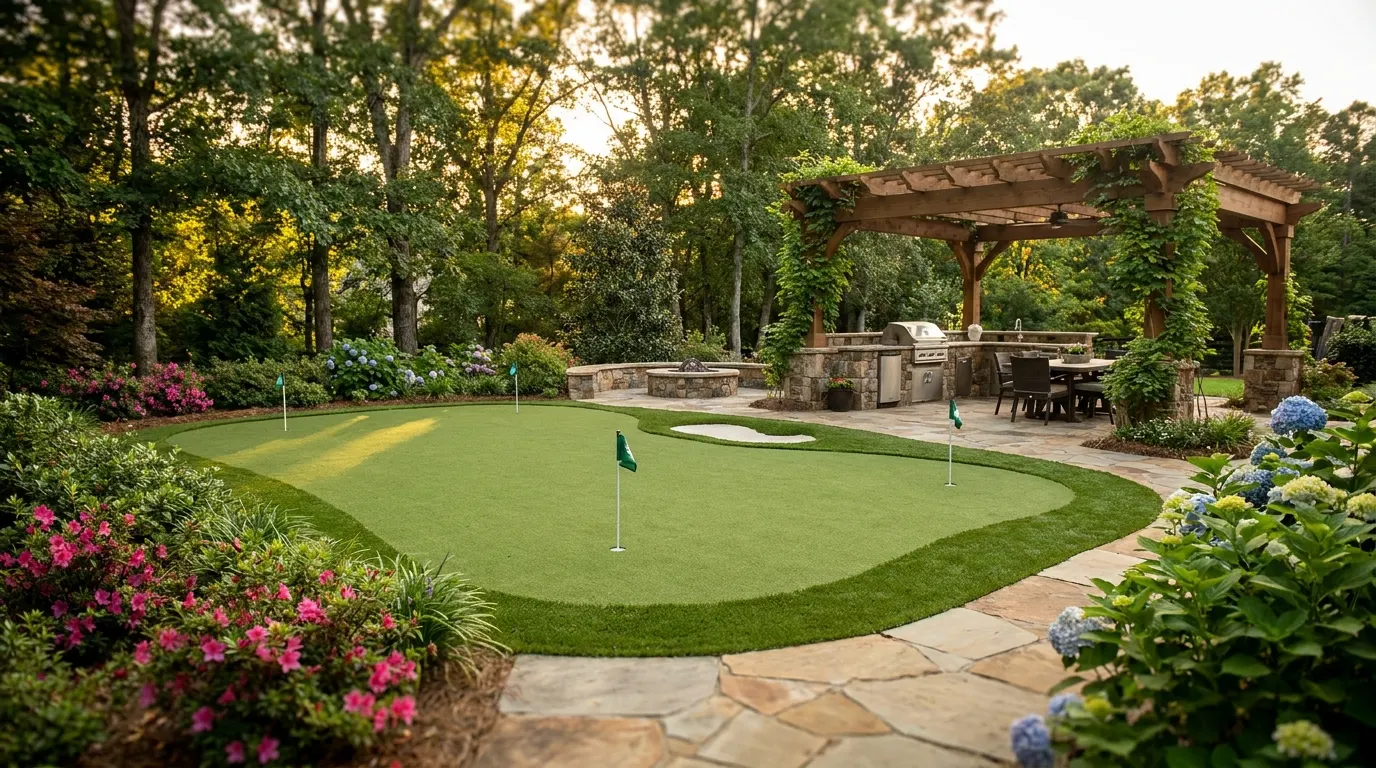
A dedicated backyard putting green in Charlotte also earns its keep as architecture. Contours can echo the patio edge. A collar of taller turf can frame the surface the way rough frames a hole. Cups can sit near a seating wall so guests can putt while someone grills. That is a recreation destination that looks designed, not a practice mat dropped on the lawn.
Natural putting greens are among the most specialized surfaces in turfgrass. In 2025, 71 percent of the samples sent to the NC State Turf Diagnostics Lab came from golf course putting greens, and bermudagrass accounted for 68 percent of those putting-green samples, a new high as the Southeast has shifted toward that grass. [5] We mention that only to honor the craft. A living tournament green is a climate-sensitive, highly managed surface. A purpose-built synthetic green gives you the daily ritual of putting without asking your backyard to behave like a golf-course agronomy program.
Choose the dedicated green if most of the play will be putting, chipping to a collar, and hosting a few friends who also love the short game.
When a multi-use turf court is the better play
Pick the court when the yard has to work for more than one sport, and for more than one age.
A turf court is a family field in a compact footprint. Kids can take shots on goal. Adults can knock a soccer ball around after work. A portable hoop can sit at one end. If pickleball is part of the picture, the official playing lines are 20 feet by 44 feet, and USA Pickleball recommends a total playing surface of at least 30 feet by 60 feet, with 34 feet by 64 feet preferred, plus a north-south orientation so players are not staring into morning or late-afternoon sun. [6] Those dimensions are a real test of a Charlotte lot. Many side yards can hide a putting green. Far fewer can hide a regulation court without rearranging the patio, the plantings, or both.
The court also wins when the household wants hours of use, not a single ritual. Researchers reviewing synthetic sport surfaces note that they can handle more playing hours than a living field, which is one reason parks and clubs have adopted them. [7] At home that simply means Saturday morning soccer and Sunday afternoon catch can share the same pad without the surface looking tired.
Pickleball's rise is part of this story. The Sports & Fitness Industry Association reports 24.3 million U.S. players in 2025, up from about 4.2 million in 2020, and ranks the sport among the 25 most-played activities in the country. [2] If that is your household, a lined court (or a court-sized turf pad that can take temporary lines) will get used. A tiny putting green in the corner will not.
Choose the multi-use court if the yard has to welcome running sports first, and putting is a welcome extra rather than the main event.
How a Charlotte lot shapes the choice
Charlotte sits in what NC State turfgrass scientists call the transition zone. Warm-season grasses struggle with our winters. Cool-season grasses struggle with our summers. The university's breeding program exists because both kinds of grass are under pressure here. [8] That climate is also why a recreation surface should be specified for this region, not copied from a catalog photo taken somewhere else.
Heat is part of the design conversation. The North Carolina State Climate Office reported that 2024 was the state's second-warmest year on record since 1895, with a statewide average of 61.5°F, and that Charlotte tied 1990 as its warmest year. All twelve months ran warmer than the historical average statewide. [9] A 2024 systematic review of synthetic sport surfaces found that surface temperatures ran 9.4 to 33.7°C higher than natural grass, while air temperature just above the surface ran only 0.5 to 1.2°C higher. The reviewers also found that fiber and infill choices can change how hot the surface feels, and that it is still uncertain whether those differences raise a player's heat-stress risk. [7] We treat that as a comfort brief, not a warning label. Shade from trees, a nearby patio roof, and a north-south court layout make summer afternoons more inviting. So does evening play under well-aimed lighting.
Rain is the other half of the brief. The National Weather Service climate summary for Charlotte uses the official 1991-2020 normal period. Through mid-August, the city's year-to-date precipitation normal is already about 28 inches, and a typical mid-August day still carries a normal high near 89°F and a normal low near 69°F. [10] Summer storms arrive fast. A play surface that ponds after a 20-minute downpour is not a destination. It is a puddle. The USGA's drain-line guidance (a continuous 0.5 percent fall, laterals no more than 15 feet apart) is written for living greens, yet the principle is the one we use on every turf court and backyard putting green: shape the base so water leaves, then specify a backing that lets it through. [3]
Lot geometry decides scale. A compact green can tuck beside a paver patio, wrap a seating wall, or sit in a sunny opening framed by plantings. A court needs a true rectangle, clear runout, and a path that does not send a ball into the grill. On a narrow Myers Park or Dilworth lot, the green often wins because it can be shaped. On a wider Ballantyne, Huntersville, or Fort Mill lot, a court can sit as its own room and still leave space for dining.
Drainage and clay soils are local facts, not a lecture. Piedmont red clay holds water. A recreation pad that ignores that will settle, ripple, and play poorly. We design the base first, then the game.
Comfort, shade, and the look of a designed yard
The finished picture should feel like Outdoor Living, not like a sports catalog landed in the grass.
A putting green looks at home when the collar, the cups, and the surrounding beds belong to the same composition as the house. We like a fringe that catches a missed putt and a planting edge that gives the green a quiet backdrop. Specimen shrubs and a small tree can throw afternoon shade without dropping a constant mess on the line of a putt.
A turf court looks at home when the lines, if you want them, are crisp, the color of the turf complements the patio, and the edges are restrained so the rectangle reads as architecture. North-south orientation is worth protecting for pickleball and for late-day comfort. [6] A low seat wall or a planting buffer can keep a hard-hit ball from becoming a neighbor conversation.
Both surfaces benefit from a place to watch. A small patio spur, a pair of chairs, a bit of shade: that is what turns a play pad into a gathering place. Our artificial turf and putting green work is meant to sit inside that larger Outdoor Living plan, not float as an afterthought.
Hybrid layouts that still feel intentional
Some households want both games. That can work if we stop thinking in full-size templates.
A compact green with two or three cups, plus a small turf lawn for catch and stretching, often fits a Charlotte backyard better than a regulation court plus a large green. Another option is a court-sized turf pad with a short-pile putting panel along one side, clearly separated so a soccer ball does not scuff the putting surface. A third option is a dedicated green as the jewel, with a modest turf landing area for chips, not a second sport.
What rarely works is asking one fiber height to do two jobs well. A long-pile court turf will not roll like a green. A true putting surface will not cushion a slide tackle. If you want both feelings, we design two surfaces, even if one of them is small.
Commercial clients ask a similar question for courtyards, amenity lawns, and office greens. The same rule holds. Match the surface to the use, then give it a drained base and a designed edge.
Practical takeaways
- Decide the primary game first. Golf as the ritual points to a dedicated backyard putting green. Mixed family sports point to a multi-use turf court.
- Measure the rectangle you actually have. A green can be shaped. A court wants a true pad, and a pickleball layout needs about 30 by 60 feet of playing surface at minimum. [6]
- Specify the surface for the ball you care about. Short, dense fibers for roll. Taller sport turf and cushion for running play.
- Treat drainage as part of the design, not a later fix. Charlotte's warm-season storms and clay soils reward a sloped, layered base. [3][10]
- Plan for summer comfort with shade, orientation, and a nearby place to sit. Synthetic surfaces can run warmer than living grass at the surface. [7][9]
- If you want both games, use two surfaces (even a small second one) rather than one compromise carpet.
- Ask for a free on-site design conversation and clear pricing before you fall in love with a photo from someone else's lot.
How we can help
At Mr. Outdoor Living, we design and build custom putting greens and turf recreation surfaces for Charlotte and the surrounding Carolinas, always as part of a larger Outdoor Living plan. Our team will walk the lot with you, listen to how your household actually plays, and prepare a free design with transparent pricing so you can see the green or the court in context before anything is installed. Making Homes More Beautiful® is the standard we hold for the finished destination, not just the turf itself. Have more questions or want to get in touch? Visit https://mroutdoorliving.com/contact/.
Citations
- National Golf Foundation, "Golf Industry Facts" (2025)
- Sports & Fitness Industry Association, "U.S. Pickleball Participation Statistics" (2025)
- United States Golf Association, "USGA Putting Green Construction Resources" (current guidance; recommendations first published 1960)
- United States Golf Association, "The GS3 Ball: Understanding the Numbers" (2024-12-06)
- NC State Extension Turf Pathology, "2025 Turf Diagnostics Lab Review" (2026-05-15)
- USA Pickleball, "Pickleball Court Construction, Lighting And Shading" (accessed 2026-08-18)
- Singh, Peterson, Jay, and Stevens, International Journal of Biometeorology / PMC, "The effect of synthetic grass sports surfaces on the thermal environment: A systematic review" (2024-05-01)
- NC State College of Agriculture and Life Sciences, "From the Ground Up" (2025-03-12)
- North Carolina State Climate Office, "The Weather Year in Review: Heat, Helene, and Weather Whiplash in 2024" (2025-01-21)
- National Weather Service, "Charlotte NC Climate Summary (CLICLT)" (2026-08-18)
Planning your own outdoor living upgrade? Explore our outdoor living services in Charlotte.