Outdoor Entertainment Area Design: Getting the TV and Sound Right in Your Charlotte Backyard
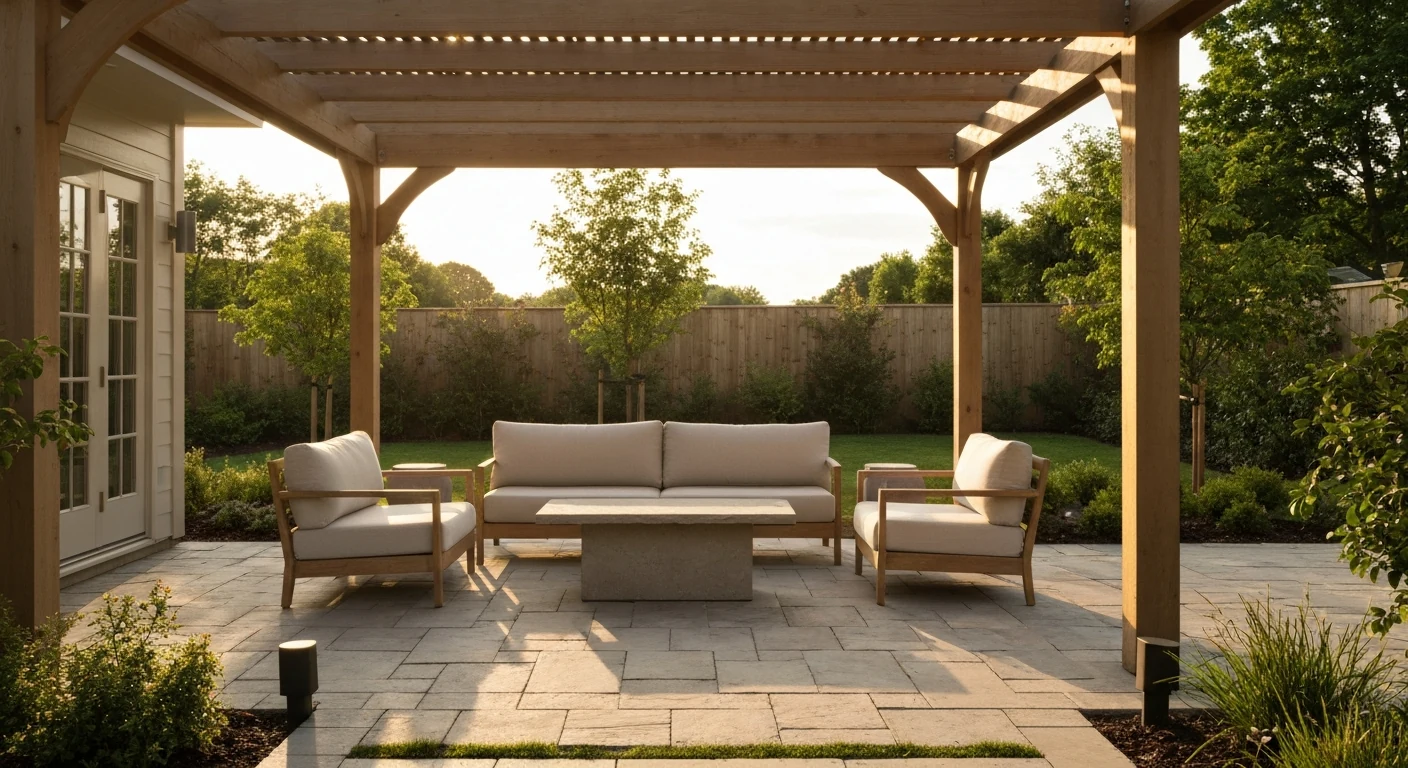
The best backyard evenings have a rhythm. The game is on and everyone can actually see it, the music sits underneath the conversation instead of on top of it, and nobody has to go inside. That is what thoughtful outdoor entertainment area design delivers, and it comes down to a handful of decisions made in the right order.
Homeowners are building for exactly this. The 2026 U.S. Houzz Outdoor Trends Study found that the share motivated by making their spaces more accommodating rose to 25 percent, up from 22 percent in 2024, while those renovating to improve resale value fell to 15 percent, down from 18 percent (2026 U.S. Houzz Outdoor Trends Study). Backyards are being designed to be lived in, and Charlotte gives you a generous season to enjoy one: NOAA's 1991 to 2020 normals for Charlotte Douglas Airport put the average daily high at 73.2 degrees Fahrenheit in April and 73.3 degrees in October (NOAA National Centers for Environmental Information).
Most people get this backwards, shopping for a screen first and hunting for somewhere to hang it. The better sequence runs the other way: read the light, set the seating, spread the sound, and choose the screen last, matched to the space you have designed.
Outdoor entertainment area design starts with the light, not the screen
The first design move costs nothing. Spend a day watching how sunlight travels across your yard, because that single observation tells you where the screen wants to live and which class of TV belongs there. Sylvox's outdoor TV guide makes the same point, recommending you assess a space by observing it across the day, not just at one moment, and identifying peak daylight as roughly 11am to 3pm.
Manufacturers have built that reality into their product lines. Samsung sells The Terrace in two distinct classes, a Full Sun model built for direct sunlight and a Partial Sun model intended for a fully or partially shaded outdoor space. Brightness is not a ranking of better and worse televisions, then. It is a match to the light your space already has, which is why the light comes first. Overhead cover expands your options considerably, and a pergola, pavilion, or gazebo is often the piece that makes a viewing area work, which we cover in our guide to choosing a pergola, pavilion, or gazebo for a Charlotte patio.
Where should you put a TV on a patio?
Put it where the light is indirect. This is the rare design question with a manufacturer's own instruction behind it: Samsung's support documentation states that The Terrace is designed for placement in a partial shade environment, which it defines as not exposed to direct sunlight but indirect or ambient sunlight instead, advises avoiding installation in direct sunlight, and notes that a roof or awning helps shelter it. Samsung also documents that dark areas can appear on screen when its surface temperature rises above 158 degrees Fahrenheit, which it says typically occurs after about ten minutes of direct sun exposure, an effect that reverses as the surface cools.
None of which means a screen cannot go in an open, sunny spot. Dedicated full sun models exist for that, and Samsung's Full Sun Terrace is offered in 65, 75, and 85 inch sizes. Both facts hold together: shade widens your options and lowers what the screen has to fight, and a full sun model is the right call when an open location is the best place for the room.
How bright does an outdoor TV need to be?
Answer by exposure class, not one universal number. SunBrite's model comparison table shows the range across its lineup: the full shade Veranda 4 is listed at 600 nits peak, while the full sun Solis Series is listed at 1,500 nits of sustained full-screen brightness. The Pro 2 Series, also rated for full sun, is listed at 1,000 to 1,500 nits. Published buying guidance maps to similar territory, with Sylvox suggesting roughly 500 to 700 nits for fully covered areas, 700 to 1,000 nits for partially shaded areas, and 1,500 to 3,000 or more for unshaded spaces in full sun.
One distinction is where spec sheets stop being comparable. SunBrite specifies its full sun Solis in sustained full-screen brightness, while the full shade Veranda figure is a peak number. Sustained output is harder to hit, so the two are not an apples to apples comparison.
Let the seating and the sightlines shape the room
Where people naturally sit decides where a screen belongs, not the other way around. Establish the gathering area first, oriented the way your family uses the space, and the screen wall reveals itself. Comfortable viewing means the seated eye line meets the picture without craning, and tilting mounts let the final angle be dialed in once furniture is in place. This is really a question of how the yard is organized into areas that each do a job, the subject of our guide to designing backyard living zones.
Sound is the layer that finishes the space
If you only do one thing beyond the seating, do the sound. CE Pro's 2026 Outdoor Technology Deep Dive reporting found that the vast majority of integrators include audio in at least 76 percent of their outdoor projects, with nearly 30 percent saying it appears in every job, while outdoor displays appear in roughly 26 to 50 percent of projects. Audio is the near universal layer, and the screen is a deliberate addition.
Outdoor sound is designed differently for a structural reason. As a Bose product manager quoted by This Old House puts it, “Indoor speakers are designed for use in a confined space. Outdoor speakers have to disperse sound over a much wider area, without the bounce provided by walls and ceilings.”. Tecnare Sound Systems describes the physics: in open air without significant reflections, sound pressure level falls by about 6 dB for every doubling of distance from the source. That is why one loud pair creates a blast zone near the speakers and a dead zone across the yard.
The design answer is a distributed array, several modest speakers spread through the space rather than two working hard. Outdoor audio specialist Scott Trusty, quoted in the same This Old House guide, puts it memorably: “Use as many speakers as you can. It’s better to use multiple speakers softly than just two speakers trying too hard.”. Fellow installer Mitchell Klein advocates a strategy he calls over-speakering, scattering speakers so there are no gaps in coverage.
This Old House notes one pair of speakers covers roughly 200 to 400 square feet, and recommends mounting speakers 8 to 10 feet high and angled slightly downward, alternating left and right channels so the stereo image holds up wherever you stand. Landscape systems work at a tighter scale, with Sonance describing its Landscape Series satellites as staked 8 to 10 feet apart through the planting beds, finished to blend among the foliage like landscape lighting, paired with a buried subwoofer. Sonance also offers a hardscape cabinet subwoofer for above ground installation, which integrates naturally into a patio's stone and paver work.
The goal throughout is comfort rather than volume. Angling speakers to keep sound inside your own yard is part of the same thinking, and This Old House recommends directing speakers away from neighboring properties.
Do you need special speakers for a backyard?
Yes, and the reasons are architectural rather than commercial. With no room acoustics working in your favor, This Old House advises that most outdoor speakers need at least 40 watts per channel to overcome ambient noise and the absence of acoustic reflection, and recommends a weather rating of IPX5 at minimum, which withstands water jets plus a warranty of two years or more. The gear is genuinely built for it: Origin Acoustics states its OS series speakers carry an IPx7 rating, meaning they can be submerged in up to three feet of water and continue to perform, and Klipsch builds its Landscape satellites and rock speakers around an extra-wide-dispersion Tractrix horn for even coverage rather than a narrow sweet spot.
Those IP codes are worth reading. As MirageVision's rating guide explains, the first digit covers solids and dust and the second covers liquids, so IP55 means dust protected and resistant to water jets from any direction, though not submersible. The shorthand is consistent across the category: Samsung rates The Terrace line IP55 and IP56, and SunBrite lists IP55 across its outdoor televisions.
Planned in, and built to stay ready
The systems that feel effortless are designed in from the start. CE Pro's reporting describes that shift, with integrators now bringing outdoor technology into early project planning rather than treating it as an afterthought. Power, speaker runs, and network coverage get planned alongside the hardscape, which is why they disappear into the finished space. Three quarters of integrators report frequently installing outdoor wireless access points, so a strong signal on the patio is part of the design, and this work belongs with qualified professionals. Qualified Remodeler reports that 68 percent of outdoor smart products purchased could be monitored or controlled from a mobile device, so the evening can begin with one tap on a phone.
Outdoor rated equipment is what keeps the space ready. Sylvox notes that outdoor televisions are rated for a far wider operating range than indoor sets, which are typically rated 32 to 95 degrees Fahrenheit, crediting sealed construction and weather sealed housings. SunBrite publishes operating ranges of 32 to 122 degrees Fahrenheit on its Veranda and Solis models and a range of minus 24 to 104 degrees Fahrenheit on the Pro 2. Gear specified for the outdoors stays installed and stays ready, so the patio is one button away on the first warm Saturday in March and on a cool October night alike.
A deliberate design decision, not a default upgrade
It is worth being straight about where outdoor entertainment technology sits in the market, because the honest picture is more flattering than the hype. Across all renovating homeowners, entertainment features are a minority choice: Forbes, reporting the 2026 Houzz study, lists outdoor system upgrades with lighting at 77 percent, lounge seating at 71 percent, fire features at 48 percent, and entertainment features at just 22 percent, and notes outdoor speakers and televisions are down from 2024.
Set that against CE Pro's finding that audio appears in at least 76 percent of professional outdoor projects and it looks like a contradiction. It is not: the studies count different people. Houzz surveys every renovating homeowner, most of whom are adding lighting and seating. CE Pro surveys custom integrators, whose clients have already decided to build an entertainment space. So an outdoor entertainment area is a deliberate design decision rather than a box everyone ticks, and those who make it overwhelmingly have it designed properly rather than improvised. Houzz found that 71 percent of homeowners hired at least one professional for their outdoor project, up from 65 percent in 2024, the highest level the study has recorded.
Designing for the Charlotte season
Charlotte hands you a long runway for this. The April and October normals are nearly identical, a neat way of saying the comfortable outdoor season runs from spring through the end of October. The back half of that calendar is where a screen earns its keep: September at 82.8 degrees and October at 73.3 land squarely on ACC and Panthers season. Summers are hot and humid, with July averaging 90.3 degrees, which is when a shaded viewing area and well spread sound make the yard the coolest seat in the house.
Your outdoor entertainment area design at a glance
- Read the light first. Watch the space across a full day before choosing anything.
- Place the screen in indirect light. Samsung directs its partial shade Terrace away from direct sun. Full sun models exist for open spots.
- Match brightness to exposure class. SunBrite's table runs from 600 nits peak on its full shade model to 1,500 nits sustained on its full sun model.
- Let seating decide the screen wall. Set the gathering area first, then align the picture to the seated sightline.
- Spread the sound. Several quiet speakers beat two loud ones. Plan at least 40 watts per channel and alternate left and right channels.
- Specify for weather. IPX5 or better on speakers, IP55 or better on a television, and an operating range that suits the Carolina calendar.
- Design the infrastructure in. Power, speaker runs, and network coverage planned with the hardscape are what make it feel effortless.
Design your outdoor entertainment area with Mr. Outdoor Living
An outdoor entertainment area is at its best as part of a complete outdoor room, and a serving counter is the natural companion to a screen and sound system. Our outdoor bar design guide for Charlotte homeowners covers that side of the build, and the two designed together carry an evening from the first guest to the last inning.
Mr. Outdoor Living designs and builds custom outdoor living spaces across Charlotte and the Carolinas, Making Homes More Beautiful® along the way. We will help you read your light, place your seating, plan the sound, and specify equipment that suits how you want to live outside.
Have more questions or want to get in touch? Visit our Contact Us page. We look forward to hearing from you.
Citations
- Houzz, "Investing in outdoor living: 5 of the biggest backyard trends of 2026" (July 9, 2026)
- NOAA National Centers for Environmental Information, "U.S. Monthly Climate Normals 1991-2020, Charlotte Douglas Airport" (1991-2020 normals)
- Sylvox, "Full Sun or Partial Sun? What is the Best Outdoor TV Type for Sunlight" (April 15, 2026)
- Samsung Electronics America, "The Terrace: QLED 4K Outdoor TV" (undated)
- Samsung Electronics America, "Enjoy your entertainment outside with the Terrace TV" (undated)
- SunBriteTV (Snap One), "Compare TVs" (undated)
- CE Pro, "Audio Still Leads Outdoor Projects, But the Tech Stack Is Expanding" (April 15, 2026)
- This Old House, "The Ultimate Guide to Outdoor Speakers" (June 3, 2026)
- Tecnare Sound Systems, "Sound Propagation in Enclosed and Open Spaces" (undated)
- Sonance, "Sonance Landscape Audio Solutions" (undated)
- Origin Acoustics, "Outdoor Audio Solutions" (undated)
- Klipsch, "Professional Series Landscape Speakers" (undated)
- MirageVision, "IP Rating Chart & Meanings for Outdoor TVs" (undated)
- CE Pro, "2026 CE Pro Outdoor Technology Deep Dive" (March 2026)
- CE Pro, "Outdoor Tech Shifts from Upgrade to Essential Category" (April 14, 2026)
- Qualified Remodeler, "Top Trends in Outdoor Projects" (April 21, 2026)
- Sylvox, "Can You Leave a TV Outside in the Cold? Outdoor TV vs Indoor TV in Winter" (December 5, 2025)
- Forbes, "New Study Reveals Latest Outdoor Living Space Trends For Our Homes" (June 2, 2026)
Planning your own outdoor living upgrade? Explore our outdoor living services in Charlotte.