Water Feature Placement Charlotte: Court vs Retreat
Opening answer (BLUF)
The first decision in water feature placement Charlotte is location, not style. An entry fountain court greets guests at the walk, from the street and from the front door. A backyard water retreat sits with the patio, where evenings actually happen. NC State Extension treats a water feature as an accent that can stand out in an orderly design, and it places a wall fountain at the entrance of a garden room so the water both draws the eye and muffles conversation [1]. Colorado State University Extension, in landscape-design guidance reviewed in 2025, distinguishes the public front yard (openly viewed by others) from the private backyard, and it lists water features among the rooms that backyard living is meant to hold [2].
Two rooms on one Charlotte lot
A Charlotte lot is already a sequence of outdoor rooms. The front walk is a public room. The back patio is a private room. The water belongs to whichever room you want to score. A millstone fountain, a wall spout, or a quiet circulating basin can live in either place. What changes is who sees it, who hears it, and when it is part of daily life. Our team starts there, on the lot, because the finished dream is a place people actually occupy.
NC State’s landscape-design chapter frames the work as arranging outdoor space so people enjoy it, with a visual relationship among the house, the site, and the neighborhood. It also asks designers to consider views from inside the house and from the street, and whether any of those views need screening [1]. Put the water where the sight line already wants a focal point. Keep it out of the views you would rather soften.
The entry fountain court: a greeting at arrival
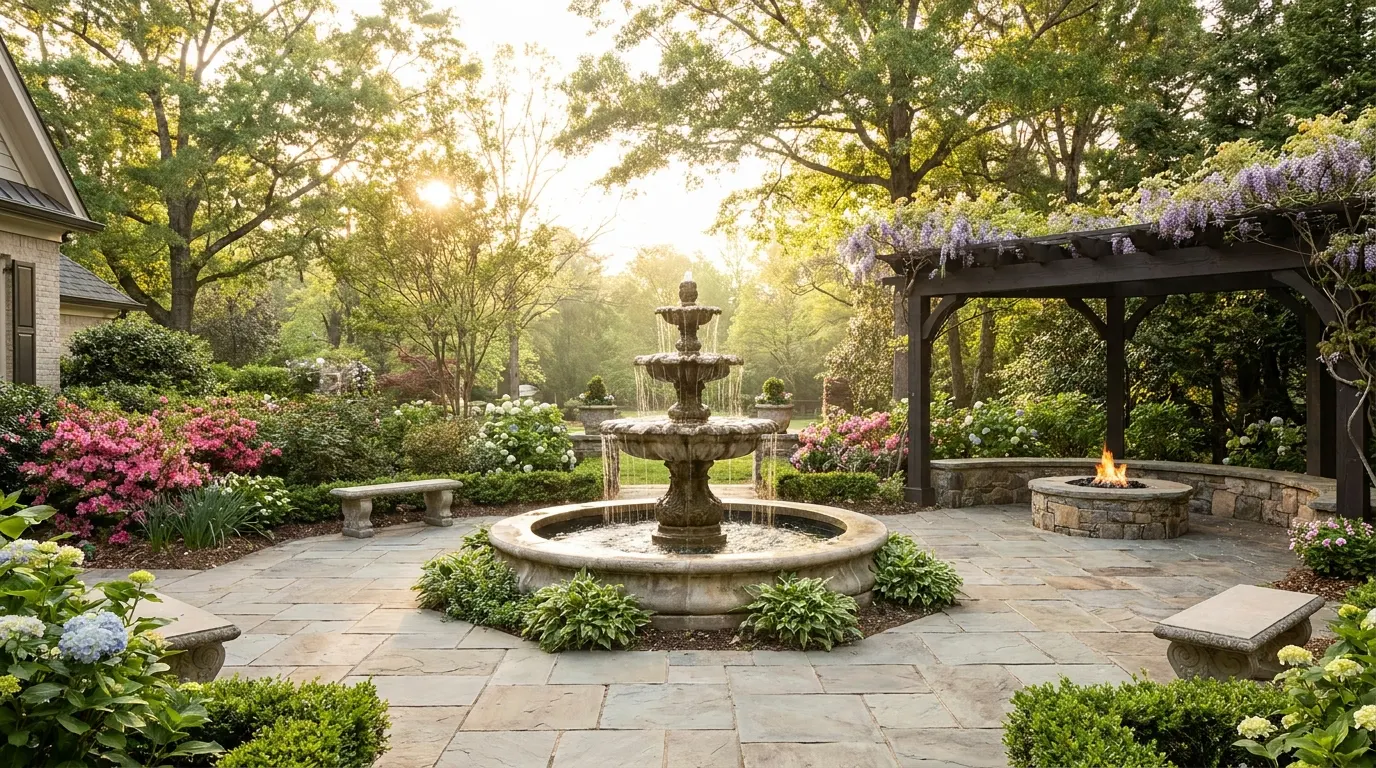
An entry fountain court is a small arrival room. It sits in the public area of the lot, typically the front yard, the space Colorado State University Extension describes as openly viewed by others and often shaped by neighborhood standards [2]. Guests meet it before they meet the door. Neighbors see it from the sidewalk. You see it when you turn into the drive.
Scale and geometry matter more here than they do behind the house. NC State notes that scale is the proportion between two sets of dimensions, such as a plant container compared to an entryway, and that objects in the landscape should have a direct geometric relationship with the building, for example on the centerline of a window or door [1]. A fountain that is too tall for the porch, or sitting off-axis from the walk, reads as leftover rather than as a court.
The sound here is a welcome, not a wall. NC State’s Plant Toolbox notes that even small water features can have a large impact, and that the sound of moving water is relaxing and can mask objectionable environmental noise such as automobile traffic [3]. On a Charlotte street with afternoon cars, that light mask is part of the greeting. It should not shout over conversation on the stoop.
USC’s 2024 campus fountain essay is a useful study of arrival. University architect Jon Soffa describes a vigorous waterfall sound as a herald that you have arrived, and associate teaching professor Jennifer Parga calls fountains places of convergence that bring people together [4]. A residential entry court is quieter than a campus plaza, but the job is the same. The water marks the threshold.
A bubbling boulder, a shallow basin with a single jet, or a wall fountain centered on the walk can all do that work. The type is only an example of what can live in the court. The court itself is the design.
The backyard water retreat: evenings on the patio
The backyard water retreat is a different room. Colorado State University Extension describes the private area, usually the backyard, as space not openly viewed by the public, designed to support cooking and eating, places to play and relax, gardens, and water features [2]. That is the Charlotte patio after work, the table at dusk, the chairs that stay out from April into November.
Here the water is scored for lingering, not for arrival. NC State describes a large outdoor garden room entered through a doorway, with a mounted wall fountain centered on that entrance to grab attention and entice people in. The same fountain muffles the sounds of voices as people talk [1]. That is the backyard job in one picture: a destination you walk toward, then a sound that lets conversation sit inside the room.
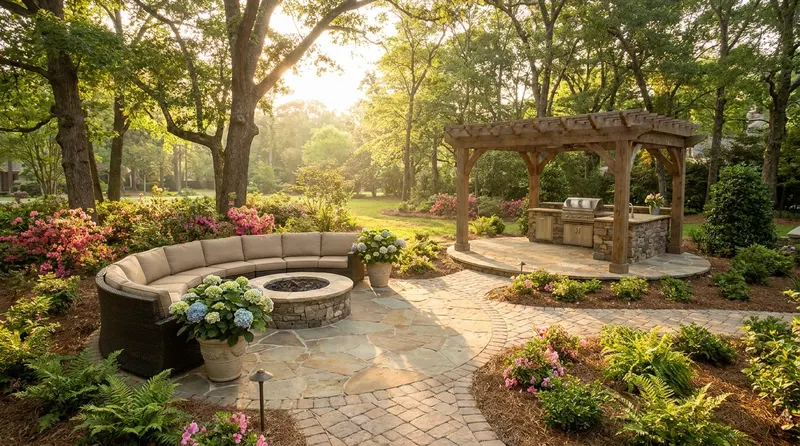
Sight lines change. From the patio, you want to see the water while seated. From the kitchen window, you want a composed view when the dishes are still in the sink. From the street, you often want less. Screening and plantings can hold the retreat as a private room, which is why our privacy landscaping work so often sits beside a backyard feature. The water is for the household, not for the sidewalk.
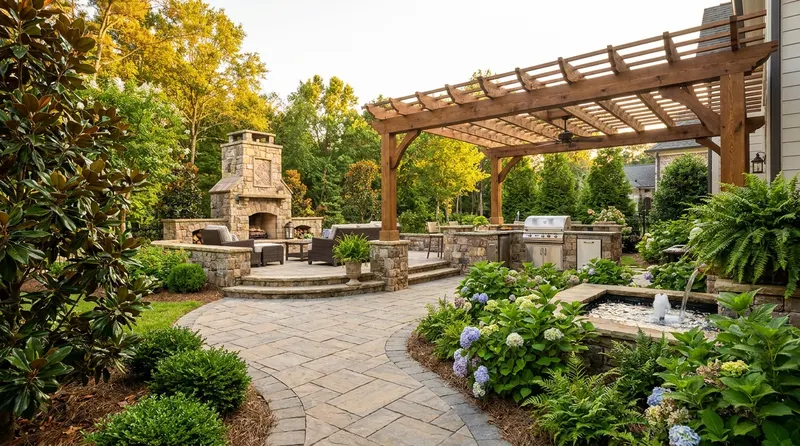
A cascading sheet beside a seating wall, a circulating basin at the paver edge, or a small waterfall tucked into grade can all serve that evening. We design the water feature as part of the patio, not as a second project dropped in the lawn. Our custom paver patios become the floor of that room.
Sight lines from the street versus from the patio
Focal points are placement tools. NC State defines them as carefully placed objects that direct a person’s line of sight, propel movement, and invite a decision about how to proceed along a path [1]. An entry fountain court uses that tool on the walk from the street. A backyard retreat uses it on the walk from the back door to the chairs.
Walk the lot twice before you choose. Stand at the curb. A fountain on axis with the front walk can complete the public room. A fountain that flashes from every passing car can feel like a display. Then sit where you actually sit: the patio, the kitchen window, the screen porch. If the water is around a corner from those seats, it will not score the evening.
NC State also notes that vertical planes (trees, shrubs, walls, fencing) frame views and terminate the sightline [1]. That is how a backyard retreat stays private without hiding the water from the people who live there. Plant the screen on the street side. Open the view on the patio side. The same water can be almost invisible from the sidewalk and completely present from the dining chairs.
Balance follows the same logic. NC State describes symmetrical balance as a formal, mirrored arrangement, and asymmetrical balance as equilibrium made from different objects [1]. An entry court often wants the more formal reading: fountain on center, walks equal, planting repeated. A backyard retreat can sit off to one side of the table so people can still walk through.
Sound as a privacy layer
Water is one of the few hardscape elements that works as both view and sound. NC State’s Plant Toolbox puts that plainly: moving water can mask objectionable environmental noise, including automobile traffic [3]. In the backyard, that mask can be a privacy layer, sitting under a closer sound that belongs to your patio.
How loud is a design choice. A high, hard fall onto stone reads as a cascade. A low, recirculating gurgle reads as a conversation partner. USC architecture professor Joon-Ho Choi, director of the USC Center for Wellness in the Built Environment, notes that fountains generate pink noise, a comfortable frequency that provides acoustic privacy for personal conversations. He also notes that interacting with a natural element like water has been shown to reduce stress and improve mood [4]. If you want private talk on the patio, put the water close enough that that sound sits with the chairs. If you want a quiet court at the door, keep the fall modest. We listen on site, at the hour you will actually be outside.
Lighting the water after dark
Charlotte evenings are long enough that a water feature without light is a daytime-only room. The goal is to see the water, the walk, and the step.
In 2020, the Illuminating Engineering Society and DarkSky International (then the International Dark-Sky Association) jointly adopted Five Principles for Responsible Outdoor Lighting. IES Director of Standards and Research Brian Liebel summarized those principles as limiting light at night to where and when it is needed, not overlighting, and remaining sensitive to environmental concerns, noting that following them results in more effective and comfortable installations [9].
A 2025 IES article on the updated DarkSky Approved Luminaires program, aligned with those principles, is more specific about residential hardware. Residential luminaires are limited to 1,000 lumens. The residential category retains a 90-degree cutoff, and the program highly recommends timers or motion sensors [10]. The same article notes that light emitted above 80 degrees from nadir is barely measurable by the time it hits the intended pathway and is therefore not useful, and that restricting high-angle light helps reduce glare, sky glow, and light trespass [10].
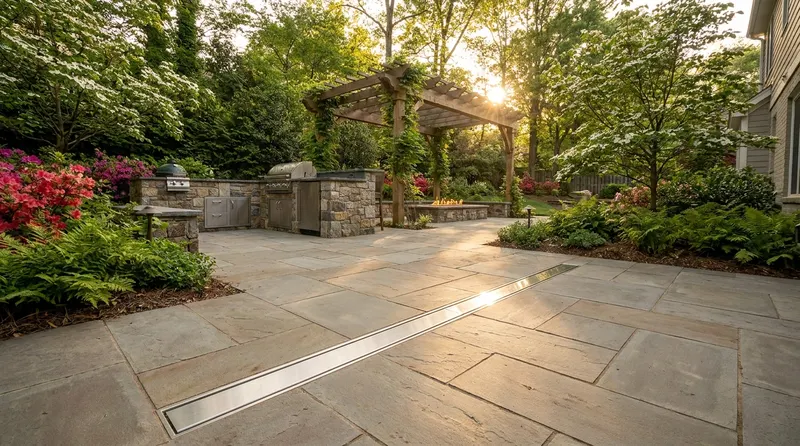
That is how we light water on a Charlotte lot. Graze the moving surface. Light the walk. Keep the source out of a guest’s eyes and out of the neighbor’s window. Our outdoor lighting work is designed around that finish. An entry court often needs a lower scene that can dim after arrival. A backyard retreat can stay on through dinner, still targeted at the water and the seating, not at the sky.
Winter on a Charlotte lot
Charlotte winter is real, and it is not alpine. The National Weather Service 1991-2020 daily normals for Charlotte put January’s monthly normal high at 52.3°F, the low at 31.8°F, the average at 42.1°F, and precipitation at 3.49 inches [11]. NC State Extension’s freeze-date chart, updated January 21, 2026 and using Charlotte Douglas Airport records from 1939 to 2019, lists an average first fall freeze of November 5 and an average last spring freeze of April 1 [12].
That is a freeze season with many nights near or just below 32°F, not a five-month ice cover. An open entry court will see nights that a sheltered patio basin may miss. Neither location is wrong for winter. Both need a plan for pumps and standing water when a freeze is forecast.
A 2020 University of Illinois Extension note is blunt about the physics: water expands as it freezes, and that expansion works against rigid fittings and piping. The same note’s weekly tip is that a pump being submersible does not mean it should stay in the water over the winter. Most small pumps need to be removed and drained. Larger submersible pumps may need to be stored in water in a location that will not freeze, and the manufacturer’s directions should lead [13]. The court or the retreat should look composed in January, then return as the same room in April.
Power, circulation, and a calm surface
Every location needs power and a circulating design. OSHA describes a ground-fault circuit interrupter as a fast-acting breaker designed to shut off electric power in a ground-fault within as little as 1/40 of a second. It compares current going to and returning from equipment, and interrupts when the difference is approximately 5 milliamperes. Units approved for outdoor use must be in enclosures suitable for the environment, and if exposed to rain they must be listed as waterproof [7].
North Carolina’s 2023 State Electrical Code fiscal note, prepared by the NC Office of State Fire Marshal for the Building Code Council, records the 2023 change at NEC 210.8(F): for dwellings where an outdoor outlet is installed, the outlet must be provided with GFCI protection. The note’s stated necessity is to address dwelling outdoor outlets subjected to rain and other outdoor elements that may create a shock hazard to personnel [8]. An entry court and a backyard retreat both sit in that weather. We plan dedicated, GFCI-protected circuits with a licensed electrician, not a cord across the walk.
Circulation is part of the design. The CDC, in an April 20, 2024 habitat overview, states that mosquito larvae and pupae live in water with little or no flow [5]. University of California Agriculture and Natural Resources, in a July 1, 2024 water-garden note, adds that mosquitoes lay eggs in, on, or near stagnant water, and that adding a fountain, waterfall, or other device that increases circulation reduces the stagnation that allows mosquitoes to breed. The same note reports that larvae prefer shallow water less than 24 inches deep [6]. Keep the water in motion and the edges clean, and the feature stays a room rather than a puddle.
An entry court in full sun may want a slightly deeper basin and a reliable loop. A shaded backyard retreat may want a quieter fall and still the same moving surface. Both belong on a Charlotte lot that is planned as a whole.
If you are still weighing water feature placement Charlotte options, start with three questions. Where do you already pause: at the front door, or on the patio after dinner? Which view do you want to keep: the one from the street, or the one from the kitchen window? And when do you want to hear water: when guests arrive, or when the household sits down? Some lots want both, a modest court at the walk and a quieter retreat at the patio. Some want one, done completely. Making Homes More Beautiful® is the standard we hold for whichever room you choose. Family-owned in the Carolinas since 1998, we design the water as part of the arrival or as part of the evening, then build it as one outdoor living plan.
Practical takeaways
- Decide the room first. An entry fountain court greets from the street. A backyard water retreat scores the patio. Style comes after location.
- Walk the sight lines. Stand at the curb, then sit in the chairs you actually use. Place the water on the view you want to keep.
- Use sound on purpose. Moving water can mask traffic and give conversation a little acoustic privacy. Match the fall to the room, not to a showroom recording.
- Light the water, the walk, and the step. Keep fixtures targeted, modest in output, and on a timer or control so the lot is not overlit.
- Plan winter and power at design time. Charlotte freezes, pumps need a freeze plan, and outdoor outlets belong on GFCI protection.
How we can help
Our team designs and builds custom water features as part of a finished Charlotte outdoor living plan, whether the water belongs at the entry, at the patio, or in both rooms. We coordinate the hardscape, plantings, lighting, and circulation so the feature feels like a court or a retreat, not an add-on. Have more questions or want to get in touch? https://mroutdoorliving.com/contact/
Citations
- NC State Extension, "19. Landscape Design" (2022-02-01)
- Colorado State University Extension, "Water-Wise Landscape Design: Steps" (reviewed 2025-07)
- NC State Extension Gardener Plant Toolbox, "Small Water Features" (accessed 2026-08-25)
- University of Southern California, "Everything you never knew you wanted to know about USC fountains" (2024-06-05)
- Centers for Disease Control and Prevention, "Where Mosquitoes Live" (2024-04-20)
- University of California Agriculture and Natural Resources, "Mosquito Management for Ponds, Fountains, and Water Gardens" (2024-07-01)
- Occupational Safety and Health Administration, "Ground-Fault Circuit Interrupters (GFCI)" (accessed 2026-08-25)
- NC Office of State Fire Marshal / NC Building Code Council, "Fiscal Note for 2023 State Electrical Code" (2023-12-12)
- Illuminating Engineering Society, "Light at Night" (2021-06-08; principles adopted 2020)
- Illuminating Engineering Society, "Let There Be Night" (2025-10-16)
- National Weather Service, "Charlotte NC Daily Normals for Years 1991-2020 (January)" (1991-2020)
- NC State Extension, "Average First and Last Freeze Dates" (updated 2026-01-21; Charlotte Douglas data 1939-2019)
- University of Illinois Extension, "How to winterize outdoor plumbing - irrigation, hoses, spigots" (2020-11-26)
Planning your own outdoor living upgrade? Explore our outdoor living services in Charlotte.