Drip Irrigation Charlotte: Drip for Beds, Spray for Turf
Opening answer (BLUF)
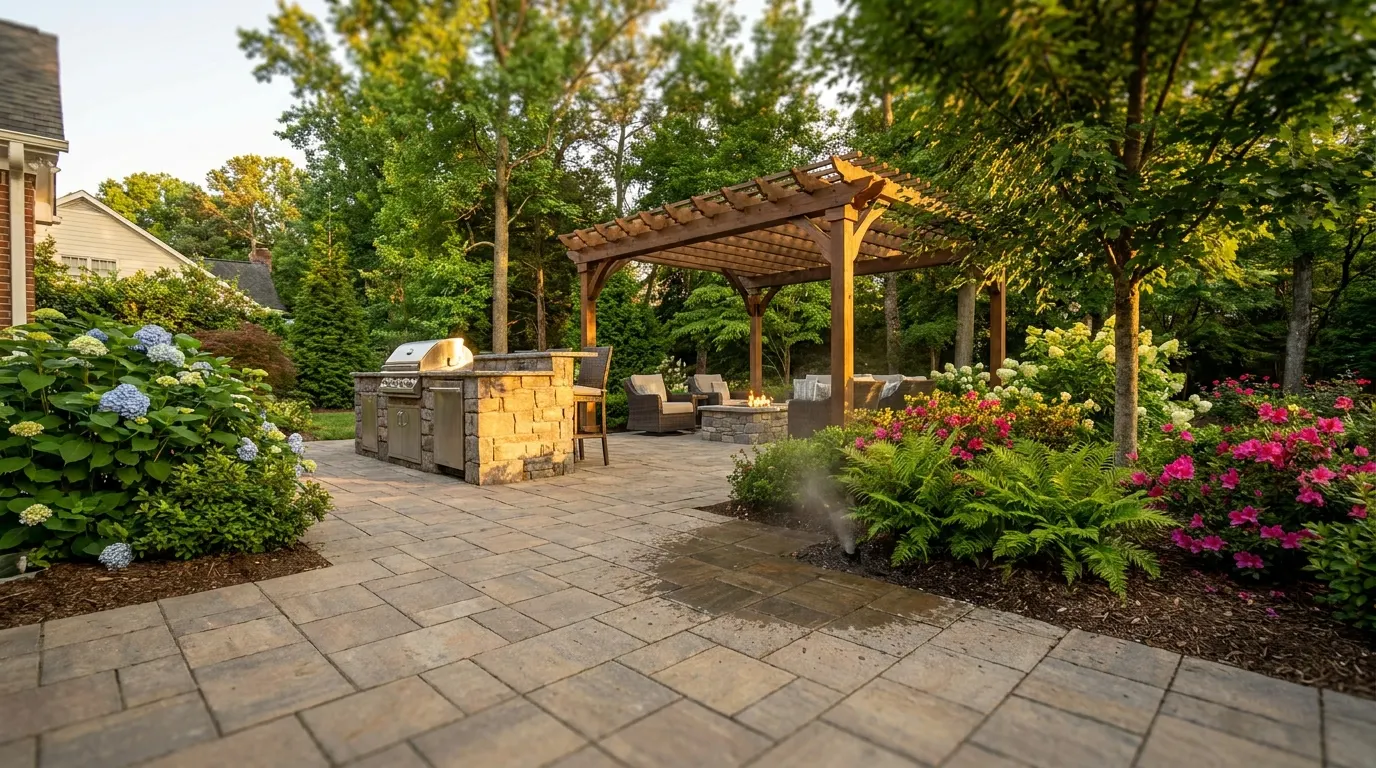
The most beautiful Charlotte yards rarely choose drip or spray. They use both. Hidden drip irrigation Charlotte systems keep beds, shrubs, and foundation plantings looking designed by placing water in the soil, not in the air. Visible spray zones belong on lawn panels, where turf needs even coverage from above. U.S. EPA WaterSense describes microirrigation as a low-pressure, low-flow method that delivers water slowly to the root zone and uses 20 to 50 percent less water than conventional sprinkler systems.[1] That pairing is lifestyle luxury, not a weekend chore. It is how Outdoor Living stays lush while you stay out of the yard with a hose.
The finished look starts with water that stays out of sight
A custom Outdoor Living space is judged on how it feels at six in the evening. Hydrangeas hold their color. Boxwoods stay tight. Lawn panels read as a green carpet between the patio and the plantings. Guests notice the gathering space, not the hardware.
When we design at Mr. Outdoor Living, we treat watering as a finish layer, the same way we treat lighting, edging, and plant placement. Hidden drip does that quietly. Tubing sits under mulch. Emitters meter a slow sip at each plant. Spray heads stay on open turf, then drop out of sight. You enjoy the patio. The system handles the soil.
EPA WaterSense notes that a typical landscape often needs about one inch of water a week, including rainfall, and that the exact amount shifts with weather, plant type, and where you live.[2] In Charlotte, that one-inch idea is a starting point, not a slogan. Beds, shrubs, and lawn panels do not share the same thirst. A designed system respects those differences.
What hidden drip irrigation actually does
Drip (also called microirrigation) is a low-pressure network of tubing, emitters, and, when a design calls for them, small bubblers. Water leaves the system in gallons per hour, not gallons per minute. It soaks the root zone instead of painting the air.
EPA WaterSense puts the plant-health case simply. Microirrigation delivers water directly where plants use it, slowly and over a longer period, which reduces evaporation and helps prevent runoff.[1] Installing a microirrigation system instead of a traditional spray layout can save a typical home more than 25,000 gallons of water a year.[1] That number is a sign of precision. The water you apply is the water the planting actually receives.
Clemson Extension's 2008 drip irrigation factsheet still gives the most useful picture of how that precision looks on the ground. Spray heads water an entire area. Drip waters the root zone near the plant. Figures of 90 to 95 percent efficiency are regularly associated with drip, and a drip zone can run at almost any hour because the foliage stays dry.[7] Dry leaves matter in our humid Carolina summers. Wet foliage is an invitation to spotting and leaf disease. Soil-level watering keeps the show above ground looking clean.
The same factsheet explains the flexibility that makes drip feel custom. Standard emitter rates are one-half, one, and two gallons per hour. On a single zone, a small perennial can receive a half-gallon emitter while a young tree receives two larger emitters.[7] After an hour, the flower has had a modest drink and the tree has had several gallons. That is how a mixed bed stays even instead of looking overwatered in one corner and tired in another.
University of Florida IFAS notes two extras we see on Charlotte properties. Water at the roots gives weeds in open mulch less of a free drink, and foliage stays drier, which can ease disease pressure.[10] Colorado State University Extension's drip guide, reviewed in 2025, places drip above 90 percent efficiency and typical sprinklers in the 50 to 70 percent range. Slow application also avoids the wet-to-dry swings that come with overhead spray, so the soil keeps a steadier air-and-water balance.[9]
N.C. Cooperative Extension in Wayne County, writing in 2024, found the same pattern. Switching overhead watering to soaker hoses and drip where possible can reduce landscape water use by up to 50 percent, because so much spray never reaches the roots.[5] Their advice to soak the soil at least 6 inches deep, rather than misting the surface every day, is the plant-health version of the same idea.[5] Deep cycles grow roots that hold a planting through a hot week.
When spray zones belong in the picture
Spray is not the opposite of good design. It is the right tool for the right surface.
A lawn panel is a continuous canopy of shallow roots. It wants even coverage across every square foot, not a drip emitter at each blade. Visible spray heads (pop-ups that rise, cover the turf, then disappear) are how we give that panel a consistent color. Rotors and matched-precipitation sprays belong on those open planes, along the edges of a patio, and in larger turf rooms that frame Outdoor Living.
The craft is in how the spray behaves. EPA WaterSense reports that outdoor use is about 30 percent of average household water nationwide, and experts estimate that as much as 50 percent of that outdoor water is lost to overwatering and inefficient systems.[3] High pressure is a common cause. Heads then mist, fog, and stripe the lawn instead of laying an even pattern.[3] Pressure-regulated, WaterSense labeled spray bodies hold a steady flow at the nozzle so coverage stays uniform.[3] Uniform coverage is what a designed lawn looks like.
Spray also needs a respectful edge. Heads should throw onto turf, not onto pavers, fencing, or glass. Overspray stains wood and slicks stone. When we set a spray zone, the patio and the planting bed stay dry while the turf drinks.
Lawns still prefer an evening-to-morning window. NC State Extension's turf water-requirements guide, reviewed in 2022, notes that the most efficient time to water is late evening through early morning, between 10 p.m. and 8 a.m., when conditions are typically cooler, calmer, and more humid.[6] That schedule also keeps the afternoon patio dry for people. Spray belongs to the lawn, and to the hours when no one is using the yard.
Why a mixed system fits Charlotte yards
Charlotte is generous and demanding in the same season. Warm days, humid nights, sudden thunderstorms, then a stretch of bright heat. Plantings that look settled in April can fade by late June if every zone runs on the same clock.
NC State Extension modeled irrigation need from long-term weather for the Charlotte area. In June, reference evapotranspiration averages 6.05 inches, while average rainfall is 3.74 inches. After rainfall is counted, the 2018 guide (reviewed in 2022) estimates about 3.13 inches of irrigation for cool-season turf and about 2.05 inches for warm-season turf that month.[6] Those are multi-year turf averages, not a promise for any single summer. They still tell a design story. A Charlotte lawn in June is working hard. A well-mulched shrub bed is not asking for the same schedule.
Clemson Extension's 2024 landscape watering guide is equally clear about the calendar. One inch of water per week is a good starting point for most South Carolina landscapes (and a useful cousin for our side of the state line), but a program that is correct in April will fall short in July and a July program will overwater in late September.[8] The climate is hotter and more stressful in midsummer. A timer that never changes cannot keep a designed yard looking designed.
That is why we separate the work. Drip zones serve planted beds, foundation shrubs, trees, and the mixed borders that wrap a patio. Spray zones serve lawn panels. Each valve can run its own minutes, its own days, and its own seasonal curve.
Piedmont soil and the pace of water
Much of metro Charlotte sits on Piedmont clay. Clay holds moisture once water enters, but it accepts water slowly. Apply a spray cycle too fast and you get puddles, shiny runoff, and dry soil an inch down.
EPA WaterSense recommends a cycle-and-soak approach on clay-rich soils and slopes: shorter runtimes with pauses so water can move into the soil instead of leaving the bed.[2] Clemson Extension's 2024 landscape water guide describes the same balancing act. Apply enough moisture for growth, not so much that the root zone fills and pushes out the oxygen roots need.[11] The luxury look is the middle: moist, aerated, even.
Drip matches clay especially well because it applies water at a trickle. Colorado State University Extension advises wider emitter spacing in clay (about 24 inches) than in sand (about 12 inches), because water spreads farther sideways in heavier soil.[9] That lateral spread is a gift when we lay tubing through a foundation bed. Fewer emitters still wet a continuous root zone under the mulch.
Slopes and narrow beds are another Charlotte reality. Side yards, berms, and the thin strip between a walk and a wall are awkward for spray. CSU Extension notes that odd-shaped and narrow areas are easy to irrigate with drip, and that the slow rate is more likely to soak in on a slope before gravity pulls it downhill.[9]
Lawn panels versus planted rooms
Think of the yard as rooms, not as one big sprinkler map.
A rectangular lawn between a Belgard or Techo-Bloc patio and a privacy planting is a spray room. A mixed border of camellia, loropetalum, hydrangea, and perennials is a drip room. A new tree in a lawn island may get a bubbler or a pair of emitters at the root ball, on its own valve, so the turf schedule does not dictate the tree's drink.
EPA WaterSense calls this hydrozoning: similar plants together, with each zone accounting for the type of emitter or sprinkler, sun or shade, and the plants themselves.[2] When azaleas, hydrangeas, and a sun-baked crape myrtle share one spray head, someone loses. When they sit on valves that match their habits, everyone looks intentional.
Design details that keep plantings looking composed
Emitters under mulch, never as décor
Clemson Extension is firm on placement. Landscape drip emitters sit above the soil and under the mulch. Buried emitters can clog with soil or invite roots. Emitters left on top of the mulch waste water saturating the bark before any of it reaches the soil, and they age the mulch faster.[7] The finished look is a clean mulch surface. The working parts stay hidden.
When we refresh mulch, we lift the tubing onto the old layer before the new mulch goes down. That small habit keeps a drip irrigation Charlotte layout working the way it was drawn.
Filters and pressure regulators belong at the valve. Drip wants low pressure and clean water. Those parts are not glamorous, but they are why a system still looks even in year five.
A controller that follows the weather, not the calendar
A clock-only timer is a convenience. A WaterSense labeled controller is closer to a good gardener. EPA WaterSense reports that replacing a standard clock-based controller with a labeled weather-based or soil-moisture controller can save an average home up to 15,000 gallons of water a year, because the system waters when plants actually need it.[4] Weather-based units read local conditions. Soil-moisture units pause a cycle when the root zone is already wet from last night's storm. You do not rewrite the clock after every afternoon thunderstorm. The planting still looks fresh.
EPA also recommends pairing those controllers with rain or soil sensors and with a professional who can set hydrozones correctly.[2] We treat the controller as part of the design conversation, not as an accessory in a box.
Deep cycles, morning hours, and the first-year planting
New plantings are not established plantings. N.C. Cooperative Extension notes that plants need routine water through the first year to settle in, while established trees and shrubs are far more independent.[5] Our layouts honor that arc: extra emitters at a new tree, a dedicated establishment schedule, then a quieter long-term program. Mulch is the partner. Extension educators point out that it reduces water loss from the soil surface and keeps beds looking finished.[5]
For spray lawns, we still prefer those late-evening to early-morning hours.[6] For drip beds, foliage is already dry, so timing is more about not running during a gathering. Either way, the hose stays in the garage.
How we design irrigation with the rest of Outdoor Living
Irrigation is one of our core services, and it is almost never a stand-alone conversation. A patio, a planting plan, and a watering plan should be drawn together. Heads should not throw onto a new patio. Drip should already be in the bed before the last shrub is set.
On our irrigation page we say it plainly: we design complete systems and smaller drip additions for new plantings. We use lasting materials, quality valves and controllers, and installation methods that respect the lawn and hardscape already in place.
The design visit is free and on site. We walk the property, talk through how you actually use the yard, and price the work transparently. You see what is included, from tubing and heads to the controller that will run them. That is the Mr. Outdoor Living way of Making Homes More Beautiful®.
Practical takeaways
- Use hidden drip for beds, shrubs, trees, and narrow or sloped plantings. Use visible spray for lawn panels that need even, overhead coverage.[1][2][7]
- Treat Charlotte's June and July heat as a design input. Cool-season turf and warm-season turf do not share a thirst, and neither should share a valve with a mixed shrub bed.[6][8]
- Ask for hydrozones. Group plants by water need, sun, and emitter type so each room of the yard can have its own schedule.[2]
- On Piedmont clay, prefer slow application and cycle-and-soak. Drip already applies water at a trickle. Spray lawns may need shorter repeats with a pause between.[2][9]
- Keep drip under the mulch, not buried in soil and not lying on top of the bark. Add filtration and pressure regulation at the valve.[7]
- Pair the system with a weather-based or soil-moisture controller so a storm can cancel a cycle and a hot week can add one, without you rewriting the clock.[4]
- Plan irrigation with the patio and the plantings, not after them. Heads, tubing, and drainage should be part of the original Outdoor Living drawing.
How we can help
If you are planning new plantings, a patio, or a refresh of an older spray-only yard, we would like to walk it with you. Our team designs drip irrigation Charlotte systems beside the spray zones lawn panels still deserve, then installs the work with the same care we bring to hardscape and horticulture. The on-site design is free, and the pricing is transparent before any trench is opened.
Have more questions or want to get in touch? Contact Mr. Outdoor Living
Citations
- U.S. Environmental Protection Agency, WaterSense, "Microirrigation" (2026-03-06)
- U.S. Environmental Protection Agency, WaterSense, "Watering Tips" (2026-03-11)
- U.S. Environmental Protection Agency, WaterSense, "Spray Sprinkler Bodies" (2026-03-06)
- U.S. Environmental Protection Agency, WaterSense, "WaterSense Labeled Controllers" (2026-03-05)
- N.C. Cooperative Extension, Wayne County Center, "Smart Watering in the Garden" (2024-07-31)
- NC State Extension, "Water Requirements of North Carolina Turfgrasses" (2018, reviewed 2022-11-23)
- Clemson Cooperative Extension, Home & Garden Information Center, "Landscape Irrigation Equipment Part 2: Drip Irrigation" (2008-05-21)
- Clemson Cooperative Extension, Home & Garden Information Center, "Landscape Irrigation Management Part 3: How Much Water?" (2024-04-18)
- Colorado State University Extension, "Drip Irrigation for Home Gardens" (reviewed 2025-08)
- University of Florida IFAS, Gardening Solutions, "Microirrigation" (2026)
- Clemson Cooperative Extension, Home & Garden Information Center, "Landscape Irrigation Management Part 1: Water in the Landscape" (2024-04-18)
Planning your own outdoor living upgrade? Explore our outdoor living services in Charlotte.