Composite Decking vs Hardwood Charlotte: Grain vs Even Color
Opening answer (BLUF)
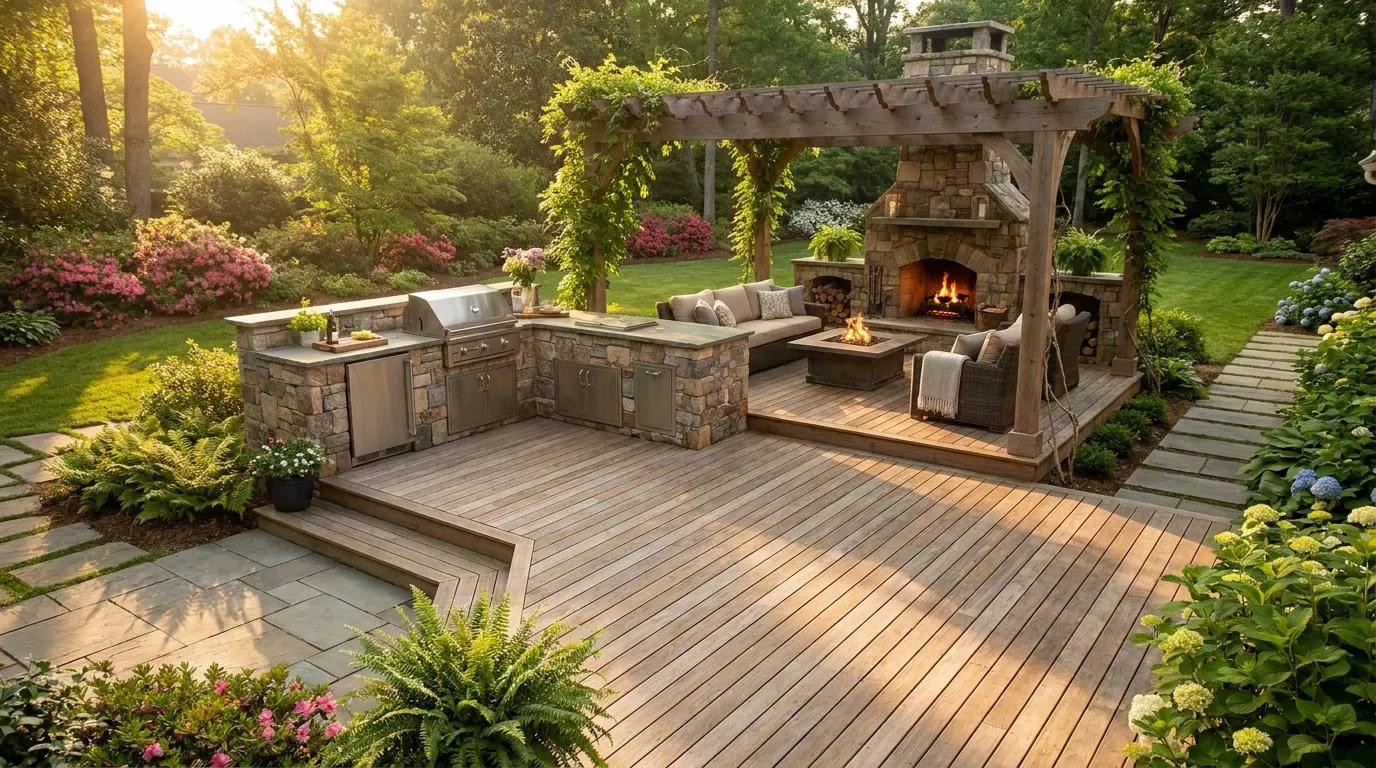
The elevated floor of a Charlotte outdoor room can be hardwood or composite, and both can sit with confidence next to a designed paver patio. Choose hardwood when you want olive-to-gold heartwood, visible grain, and a board that feels like timber underfoot. Choose composite when you want a more even color field, a manufactured palette, and a deck board rated to a published exterior standard. The USDA Forest Products Laboratory notes that wood-plastic composites first found their North American construction market in decking, and that ASTM D7032 is the standard used to rate those boards for exterior use [1].
The floor you live on
When guests walk out of the house, they do not meet a product category. They meet a floor. In Charlotte, that floor often sits a few steps above the garden, then drops to a dining patio, a kitchen island, or a fire court. The real composite decking vs hardwood Charlotte question is about mood. Does this outdoor room feel like a timber porch at golden hour, or like a tailored lounge that holds a consistent color through a long summer?
Our team designs that sequence as one outdoor living plan. The boards are the elevated floor. The patio is the ground-level room. Furniture, lighting, and how people move between the two matter as much as the species or the polymer blend. Family-owned in the Carolinas since 1998, we start with the finished picture: how the floor meets the pavers, and how it feels when you are hosting.
Hardwood character: grain, color, and a floor that reads as timber
The Forest Products Laboratory's Wood Handbook opens its species chapter with a simple truth: the grain patterns and colors of wood make it an aesthetically pleasing material [2]. That is why a hardwood deck still stops people at the threshold. Each board carries its own figure. Light rakes across interlocked grain in the morning and flattens it at noon. After a July shower, the color deepens, then eases back as the sun returns.
Ipe, a common name for the lapacho group of Handroanthus species from Latin America, is one of the hardwoods specified for decks. The 2021 Wood Handbook describes its heartwood as light to dark olive brown, with a fine to medium texture and grain that is straight to very irregular and often narrowly interlocked. At 12 percent moisture content it is very heavy, about 64 pounds per cubic foot, and its hardness is two to three times that of white oak. The same chapter rates the wood as highly resistant to decay and insects, including subterranean and dry-wood termites, and lists decks among its uses [2].
Teak tells a warmer story. Its heartwood varies from yellow-brown to dark golden brown and turns a richer brown with exposure to air. The Wood Handbook describes teak as usually straight grained, with a distinctly oily feel, excellent dimensional stability, and a very high degree of natural durability [2]. On a Charlotte evening, that oil-rich surface reads as hospitality.
Those heartwoods are why hardwood still belongs in a humid Piedmont climate. They are a color story as much as a durability story: olive, gold, chocolate, and the slow shift toward a silvery-brown weather tone if you let the timber live outdoors without a tinted finish. Some homeowners want that drift. Others prefer a stain that holds a chosen hue. Either way, the floor stays recognizably wood.
Western redcedar and redwood appear in the same handbook as lumber used for decking. Western redcedar heartwood is described as very resistant to decay, and redwood is valued for outdoor uses that include decking and outdoor furniture [2]. They sit in a lighter, more aromatic register than ipe. If your patio pavers are cream or buff, a cedar floor can feel like a continuation of the house trim. If the patio is charcoal or slate, ipe's olive-brown can be the warm counterpoint.
A 2024 BioResources study on heat-treated wood found that color and grain contrast strongly influence preference, and that preferred wood surfaces gave people impressions of warmth, weight, cost, prevalence, and comfort. The authors also note that wood's unique color and grain create a warm visual sense and a comfortable, relaxed state of mind [3]. That is the hardwood pitch in one sentence: the floor is part of how the room feels, not only how it performs.
Composite character: a designed color and a steady board
Composite decking is a different kind of floor. The Forest Products Laboratory describes wood-thermoplastic composites, often called wood-plastic composites or WPCs, as commercial construction products whose North American market began with decking and window profiles, then moved into railing, siding, and roofing. In the most common WPCs, the thermoplastic is a continuous matrix and the wood or other lignocellulosic content is typically less than 60 percent by weight [1].
That mix is why a composite board can hold a color that does not depend on a particular tree's heartwood. You can specify a driftwood gray that sits next to cool contemporary pavers, a warm walnut that belongs with cobble, or a pale sand that keeps a south-facing deck visually light on a 90-degree afternoon. The boards can be embossed with a grain pattern, but the pattern repeats by design. For many households, that evenness is the point. The floor looks composed in photographs. It looks composed when a full table of guests is standing on it with plates in their hands.
ASTM D7032 is the standard specification for establishing performance ratings for wood-plastic composite and plastic lumber deck boards, stair treads, guards, and handrails. ICC Evaluation Service describes the standard as covering thermoplastic-based products in any code-compliant shape, and as the basis for code recognition in exterior applications. Material tests include temperature effects at 125°F and minus 20°F, moisture, ultraviolet resistance, freeze-thaw, fungal decay, and termite resistance, along with flexural performance, creep recovery, fasteners, and (when required) slip resistance [4]. That is the modern composite story: a board whose color and profile are chosen for the room, with a published rating behind the installation.
Color still lives outdoors. A 2008 Forest Products Laboratory study found that wood-plastic composites faded more when exposed to a combination of light and water spray than when exposed only to light, suggesting that loss of color-imparting wood extractives can play a part [5]. That research is nearly two decades old, and later product design (including the ultraviolet testing built into D7032) exists because color is part of how people choose a floor. In Charlotte, where summer light is strong and afternoon storms are part of the season, we treat color as a design decision: lighter boards for a sun-washed lounge, deeper tones where an overhang or a tree already softens the glare.
The U.S. Environmental Protection Agency, in its chromated arsenicals overview updated December 22, 2025, notes that before 2004 wood treated with chromated arsenicals was used in residential structures such as decks and playsets, and that manufacturers voluntarily discontinued those homeowner products in December 2003. Among the alternatives EPA lists are wood treated with other approved preservatives, wood-alternative and composite materials, and species of wood that are resistant to pests [6]. Composite and hardwood both sit on that official list. The choice is not "real versus fake." It is which floor belongs in your room.
How the elevated floor meets a Charlotte patio
A deck is not a patio, and a patio is not a deck. The pleasure is in how they meet.
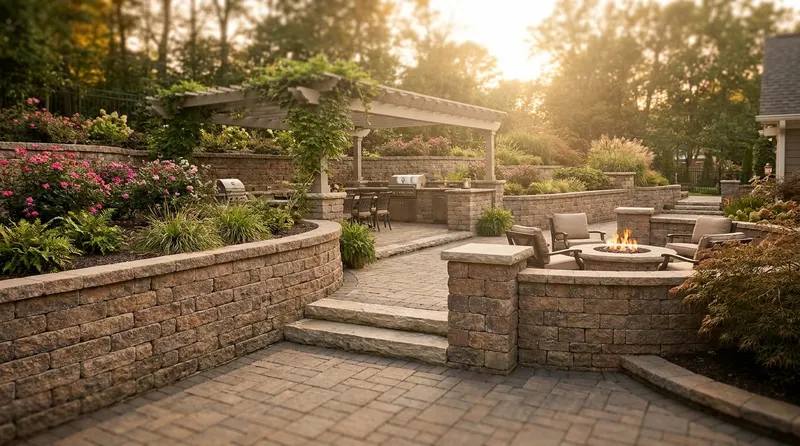
We design many Charlotte outdoor rooms as a pair: an elevated timber or composite floor off the back door, then a step or two down to an interlocking paver patio that holds the table, the grill, or the fire. The Concrete Masonry and Hardscapes Association's 2022 application guide treats interlocking concrete pavements as appropriate for patios and related pedestrian surfaces. Those pavers are factory-made from portland cement, fine and coarse aggregates, and typically color pigment, molded under pressure and vibration into dense, high-strength units. For pedestrian applications, 2 3/8-inch (60 mm) thick pavers are recommended, and the finished field is compacted on a sand bed with sand-filled joints and a required edge restraint [7]. That is a different construction language from deck boards on joists, which is exactly why the joint between them should be designed, not left as an afterthought.
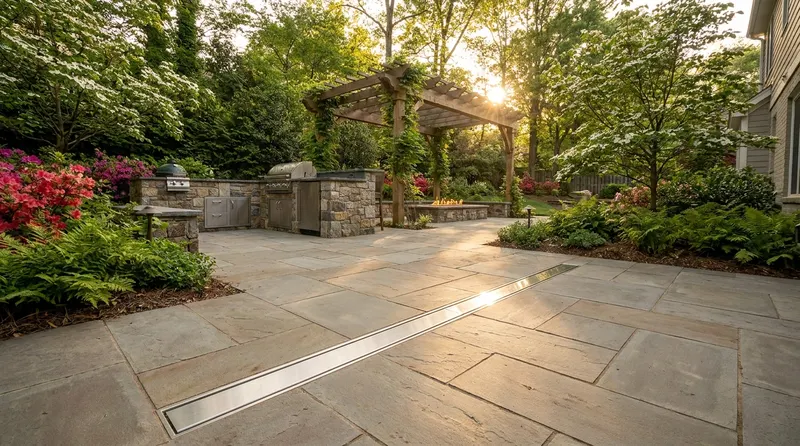
Color is the handshake. Olive-brown ipe next to a warm cobble field feels like one family of materials. A cool gray composite next to a contemporary large-format paver feels like a modern house continuing outdoors. A mismatch (a yellow-green leftover board against charcoal slabs, or a red-brown composite against a pink-tan patio) reads as two leftover projects. We sample boards on the actual patio, in sun and in shade, because Charlotte light is not showroom light.
Height is the second handshake. The deck should arrive at the patio as a comfortable step, with a clean fascia, a nosing you can see at dusk, and a place for water to leave both floors. Our custom paver patio work is built around Belgard and Techo-Bloc units chosen for the Carolinas climate, including freeze-thaw movement and the region's red clay. The elevated floor should respect that same grade story: the boards shed toward the patio or toward a designed edge, and the pavers continue the slope so a summer thunderstorm does not pond at the bottom step.
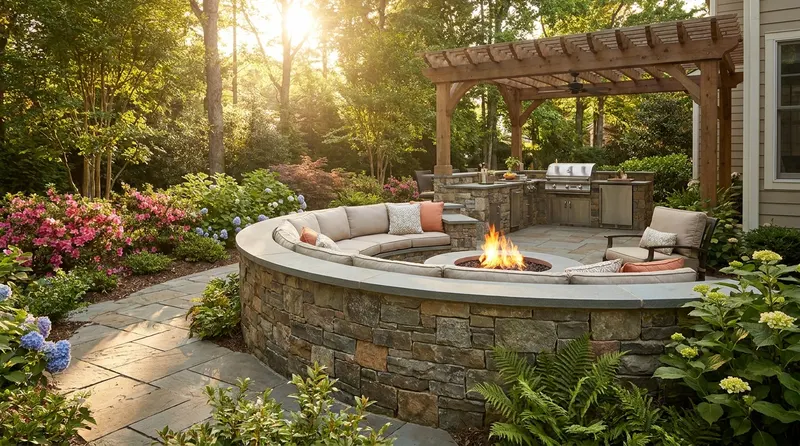
Furniture tells you if the meeting worked. A lounge grouping on the deck, a dining table on the patio, and a path that does not pinch between them. If you cook outside, the outdoor kitchen usually wants the more solid, ground-level paver floor, while the elevated boards become the cocktail terrace. If you linger after dark, outdoor lighting should graze both surfaces so grain, pigment, and the step itself stay readable.
Charlotte sun, humidity, and the long hosting season
North Carolina has a humid climate with very warm summers. NOAA's 2022 State Climate Summary describes how the Bermuda High draws moisture from the Atlantic and the Gulf of Mexico, producing warm, moist summers with frequent afternoon and evening thunderstorms, and notes that precipitation is generally highest in summer, with a peak in July. Statewide, the long-term summer average temperature is 75.6°F, and the 2015 through 2020 summers were the warmest on record in that dataset [8].
Charlotte's own 1991-2020 daily normals put a finer point on the season you will actually host in. In July, the National Weather Service climate record for Charlotte shows a monthly normal high of 90.3°F, a low of 69.9°F, an average of 80.1°F, and 3.74 inches of rain [9]. Across the year, the same normal series totals 43.6 inches of precipitation [10]. That is a long, warm, occasionally wet outdoor season, not a two-month deck. The elevated floor should feel good in June at 7 p.m., in August after a storm, and in October when the patio is still the dining room.
We use that climate as a palette, not a warning. High sun argues for a color you will still like when it is bright. Warm nights near 70°F in July argue for a surface you want to stand on after dinner. Humidity and rain argue for a floor that still looks finished when it is damp: hardwood grain that darkens honestly, or a composite hue that was chosen to look right wet. Shade from a pergola, a tree, or the house itself is part of the same design, because comfort on a 90-degree afternoon is as much about cover as it is about the board.
Hosting on two floors
Picture a Saturday with a deep Charlotte backyard. People gather first on the elevated floor, looking over the plantings, then drift down to the patio for dinner. Children cut across both surfaces. Someone leans on the rail. Someone else stands at the kitchen counter. The floor has to take all of that without feeling like a compromise.
Hardwood rewards the guest who notices things: the way one board is a little more olive, the way the grain runs toward the steps, the faint scent of timber after rain. Composite rewards the host who wants the room to look set every time the door opens: a consistent color, a repeating texture, a floor that photographs like the rest of a tailored hardscape.
Neither choice is a lesser outdoor room. The EPA's list of alternatives after residential chromated arsenical lumber left the consumer market includes both pest-resistant wood species and composite materials [6]. The Forest Products Laboratory treats both timber species and wood-plastic deck boards as serious construction products [1][2]. Your job, with our help, is to pick the one that matches the patio, the furniture, and the way you actually live outside.
If you are still weighing composite decking vs hardwood Charlotte options, start with three questions. What color do you want beside the pavers at 10 a.m. and at 6 p.m.? Do you want grain that varies board to board, or a more even field? And where do people actually stand when you host: on the elevated floor, on the patio, or constantly moving between them? Those answers will do more for the finished room than any generic ranking of the two materials. Making Homes More Beautiful® is the standard we hold for that finished room.
Practical takeaways
- Walk the patio first. Lay hardwood and composite samples on the actual pavers, in sun and in shade, before you commit to a catalog swatch.
- Decide whether you want grain that varies board to board (hardwood) or a more even, designed color field (composite).
- Pair undertones on purpose: olive and gold hardwoods with warm pavers, gray and driftwood composites with cooler stone.
- Treat the step between deck and patio as a designed threshold, with a visible nosing, a comfortable riser, and a place for stormwater to leave both floors.
- Plan the elevated floor as lounge and arrival, and the paver patio as dining, kitchen, and fire, so hosting has a natural circuit.
- Use Charlotte's long, humid summer as a color test. The floor should still look like your outdoor room after a July storm and at 7 p.m. on a 90-degree day.
How we can help
Have more questions or want to get in touch? Visit our contact page to start a conversation about the elevated floor of your outdoor room, the patio it meets, and a plan that fits how you host in Charlotte.
Citations
- USDA Forest Products Laboratory, "Chapter 11: Wood-Based Composite Materials" (2021)
- USDA Forest Products Laboratory, "Chapter 2: Characteristics and Availability of Commercially Important Woods" (2021)
- BioResources (NC State), "Effect of changes in surface visual properties of heat-treated wood on the psychological preference" (2024)
- ICC Evaluation Service, "ASTM D7032 - Composite Deck Board and Railing Testing" (accessed 2026-08-25)
- USDA Forest Products Laboratory, "Improving the color stability of wood-plastic composites through fiber pre-treatment" (2008)
- U.S. Environmental Protection Agency, "Chromated Arsenicals (CCA)" (2025-12-22)
- Concrete Masonry and Hardscapes Association, "Application Guide for Interlocking Concrete Pavements (PAV-TEC-010)" (2022)
- NOAA / NCICS, "North Carolina State Climate Summary 2022" (2022)
- National Weather Service, "Charlotte NC Daily Normals for Years 1991-2020 (July)" (1991-2020 normals)
- National Weather Service, "Charlotte NC Daily Normals for Years 1991-2020 (December)" (1991-2020 normals)
Planning your own outdoor living upgrade? Explore our outdoor living services in Charlotte.