Four Season Plantings Charlotte: Evergreen Then Color
Opening answer (BLUF)
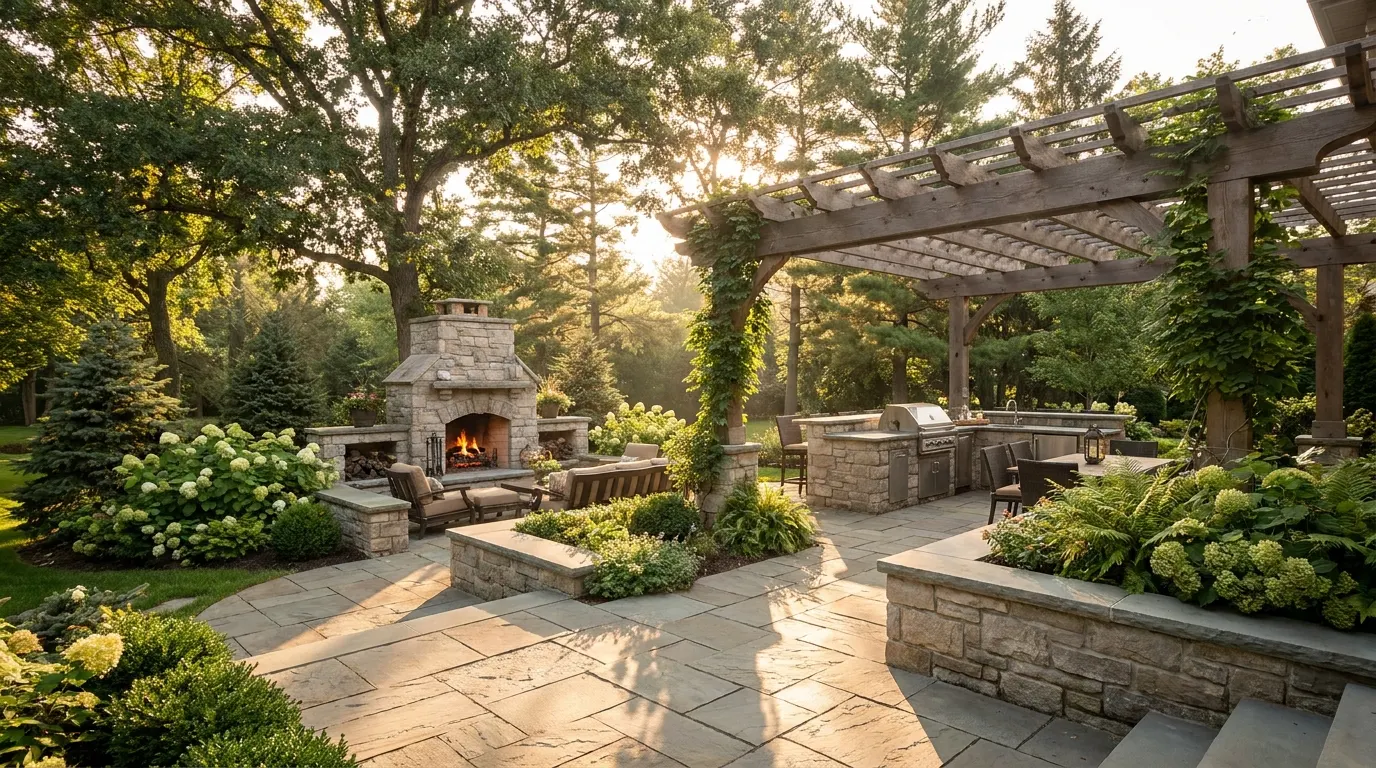
The finished year-round picture on a Charlotte lot is simple to see and harder to fake. Evergreen shrubs and small trees hold the outdoor rooms through winter, so the patio still has walls, a backdrop, and a view from the kitchen window. Seasonal color beds then bring movement in spring and fall, the weeks when you actually live outside the most. NC State Extension is clear that the main plant colors in a good design are the shades of green that set off those seasonal accents, and that too many evergreens can feel heavy because they give less change than deciduous plants. [1]
At Mr. Outdoor Living, we treat four season plantings Charlotte homeowners ask about as architecture for Outdoor Living, not as a flower list. Evergreen structure should lead when a room needs privacy, winter presence, or a calm green frame around the patio. Color should lead when a walk, dining terrace, or window wants a seasonal moment. Most of our favorite yards use both.
Outdoor rooms need walls, not just bloom
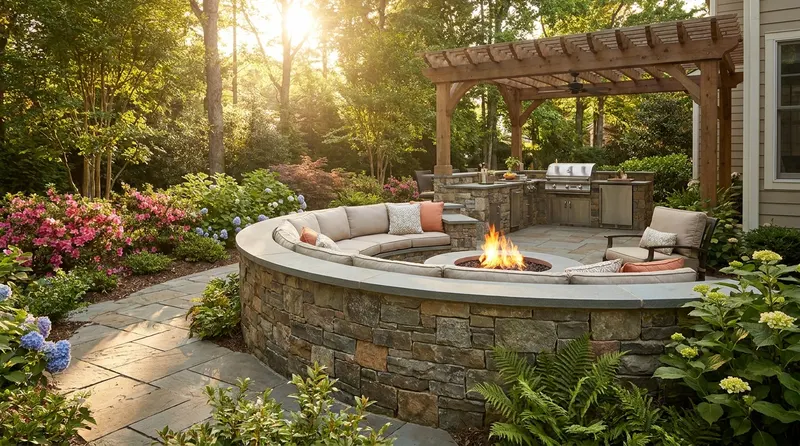
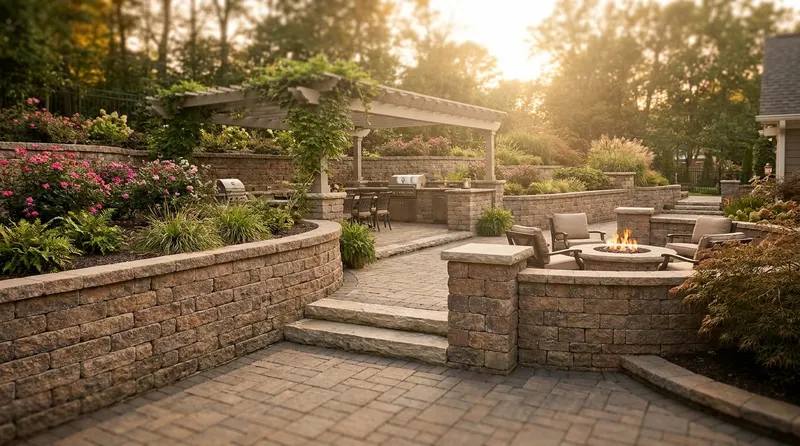
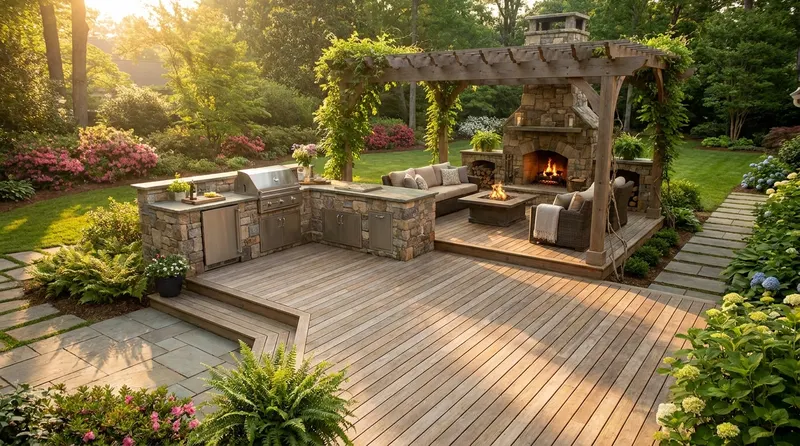
A planting is not decoration sprinkled around a patio. It is the wall, the backdrop, and sometimes the ceiling of the room you sit in. NC State Extension describes a garden room the same way we describe a house: a space enclosed by walls, a floor, and a ceiling, with the difference that outdoor materials are living and may not have a full overhead plane. [1] The patio is the floor. Shrubs, hedges, and small trees are the walls. A tree canopy or a pergola is the ceiling.
Clemson Extension makes the same point in plainer language. Evergreens and plants with strong winter forms give the basic year-round structure, and those plantings plus the hardscape (paving and walls) are the equivalent of floors, ceilings, and walls in outdoor rooms. [2] That is why tulips alone cannot hold a dining terrace in February, and why a solid holly wall with no color pocket can feel static by June.
Woody plants do the architectural work because they stay aboveground. NC State’s woody-ornamentals chapter calls them the living, structural components of a well-landscaped yard. Shrubs help define areas. Groups establish a framework. Evergreens provide winter interest after deciduous plants drop their leaves. [3] When we design plantings beside a patio, we start with those woody bones, then decide where color is allowed to move. NC State also notes that with North Carolina’s pleasant climate, outdoor activities can be enjoyed most of the year, so patios belong in the plan as true living space. [1]
Evergreen structure: the bones that stay
Winter is the honest season. N.C. Cooperative Extension’s Beaufort County gardeners put it well in a February 2026 column: winter strips the garden down to its bones, so you can finally see what is working. Trees frame the property. Shrubs, especially evergreens, show whether the garden has winter presence or simply disappears until April. [5] Sit on the patio in January. Look back from the kitchen. If the space still has a wall of foliage and a framed view, the bones are doing their job. If the bed has gone flat, color plants were asked to do architecture they cannot do.
University of Georgia Extension adds the color reason. Evergreen foliage provides permanent color because the plants stay green year-round. Deciduous plants drop their leaves, yet they can still offer winter interest in bark and branch structure. Some plants hold berries. Ornamental grasses often turn a pleasant tan or gold. [6] Those quieter winter colors sit against the evergreen wall the way furniture sits against a painted room.
Clemson horticulture specialists, writing in 2026 about plants that hold a landscape past a single bloom season, keep returning to two Piedmont families we use as bones. Camellias give year-round structure and color when you need it most, with blooms in the cooler months when most landscapes are quiet. They are adapted to Zones 7a to 9a and work as foundation plants, specimens, and shaded borders. [10] Hollies offer evergreen structure, berries, and year-round presence, with cultivars for screening, foundation plantings, and winter interest. [10]
NC State’s plant toolbox backs both for the Piedmont. Japanese camellia is a broadleaf evergreen shrub or small tree hardy in Zones 7a through 9b. Depending on the variety, flowering may start as early as October and finish as late as mid-March, with each plant usually blooming for three to four weeks. [11] Yaupon holly is a woody broadleaf evergreen also listed for the Piedmont in that same hardiness range, useful as a sheared screen, hedge, foundation planting, or winter-garden specimen. Female plants hold showy red fruit into winter when a male plant blooms at the same time. [12]
We do not plant a catalog of these shrubs. We place a few well-chosen masses so the patio has a wall and the view from inside still has green. NC State says to choose the woody ornamentals first because they establish the borders, hedges, and specimen plantings that give structure and form. It also warns that evergreens can become visually heavy if they crowd out seasonal change. [1] The bones should hold the room. They should not fill every inch of it.
Seasonal color beds: the movement
Once the walls are in place, color can move. Herbaceous plants change the temperature of a room from month to month. NC State describes them as plants that add depth, dimension, form, and texture, with flowers often the stars. Annuals bloom more quickly and for a longer period than any other group and can give a massive display of color. Perennials usually flower for only a few weeks each, but careful planning produces a succession of bloom. Combining annuals with perennials fills the gaps. [4]
That is what a seasonal color bed is for. It is not the wall of the outdoor room. It is the movement inside the room: pansies against a holly hedge in late winter, azaleas at the edge of a dining terrace in April, a summer band of warm-season annuals, then fall color from late perennials and turning foliage. NC State’s landscape chapter is specific about the calendar. Flowering trees give pastels in spring. Beds of perennials and annuals furnish vivid hues in summer. Hellebores offer bursts of color in late winter. Evergreens add winter color and unity. A river birch can carry spring flowers, midsummer or fall color, and exfoliating bark for winter. [1]
Clemson’s 2026 guidance on thinking beyond short bursts of color is useful here. Azaleas, both evergreen and deciduous, remain one of the Southeast’s most recognizable seasonal moments and perform best in slightly acidic, well-drained soil with afternoon shade. Eastern redbud is a homeowner-friendly way to bring early spring color without asking the tree to do every other job. [10] We use those plants as accents against the evergreen frame, not as a substitute for it.
University of Georgia Extension notes that cool colors recede and can make a courtyard feel larger, while warm colors advance and can make a space feel closer. [6] NC State adds a viewing note: a mass of a single color has a stronger impact than a mixed scatter, and white is the last color to fade as darkness falls, which makes it generous near a patio used at night. [4]
The calendar in Charlotte is generous. Long-term records at Charlotte Douglas International Airport, covering 1939 to 2019, place the average first fall freeze around November 5 and the average last spring freeze around April 1. [9] That window is why color can work in spring and again in fall, and why winter annuals such as pansies (planted after the soil cools) can keep a pocket of bloom through the milder weeks. [4]
When evergreen structure should lead
Evergreen structure should lead when the planting is doing the work of a wall.
It should lead along a property line or beside a neighbor’s second story, where privacy landscaping has to hold in January as well as in June. NC State says that if a site analysis calls for screening, a noise barrier, or privacy, plant evergreen shrubs or build a fence, and that a natural evergreen hedge is a good option when there is room. [1] Yaupon holly, used as a mass and sheared, is one of the Piedmont plants NC State lists for that screen, hedge, or barrier role. [12]
It should lead where you look from inside the house all winter. Clemson asks that plants nearest an entrance stay interesting throughout the year because they will be seen closely. [2] The same rule applies to the view from a breakfast table. A camellia or holly mass does that work. A bed that is only perennials will not.
It should lead beside a formal patio or a house with strong horizontal lines, where the outdoor room wants a calm backdrop. NC State’s rhythm example uses repeating dome-shaped boxwood to draw the eye through a landscape. [1] A repeated evergreen form does the same next to pavers.
It should lead when the lot is small and the patio is the main room. On a tight Charlotte lot, you cannot afford a planting that vanishes for five months. Color then occupies the front of the bed and the pots on the terrace, rather than the whole composition.
When seasonal color should lead
Seasonal color should lead when the planting is doing the work of a welcome or a change of mood.
It should lead at the arrival, where guests walk from the drive to the door or around to the patio. A concentrated band of spring bloom, then a second band in fall, tells people they have entered a designed place. NC State’s advice is to concentrate color where accent is desired, and to remember that more is not necessarily better. [1] One generous drift reads more clearly than five competing flower types.
It should lead on the dining terrace and around the seats you actually use in April and October. That is when Charlotte outdoor rooms are at their best. Warm-season annuals can hold the summer stretch. Cool-season annuals and late perennials can pick the season back up as evenings cool. [4]
It should lead where a deciduous tree already gives you a seasonal story. A redbud’s early bloom or a river birch’s peeling bark is a designed moment. [1][10] Evergreens should sit behind or beside those plants so the moment has a green stage.
It should lead in containers on the patio itself. Pots let color change without asking the architecture to change. The holly hedge stays. The urns can move from winter pansies to summer annuals without rewriting the outdoor room.
Color should not lead when it is being asked to hide a missing wall. If a patio feels exposed in winter, the answer is structure, an evergreen mass, a small tree, sometimes a privacy wall, and then color in front of it.
How the two work together through the year
The best four season plantings Charlotte outdoor rooms can offer are a conversation between the two, not a contest.
NC State’s sequence is the one we follow. Select the woody plants first. Group shrubs and trees with similar needs in mulched beds rather than scattering them through the lawn. Plant woody plants in masses so they provide winter structure. Then add bulbs, herbaceous perennials, or annuals for seasonal color. Large sweeps of perennials and ornamental grasses can add winter form of their own. [1] When you design a bed, group plants by height, put the tallest toward the back, and use plants that stay interesting when they are not in bloom, including grasses and evergreen shrubs. [4]
That layering is what a January walk and an April dinner have in common. In winter you read the bones: holly, camellia, yaupon, the patio edge. [5] In spring the color beds wake against that green. In summer the greens carry the room again while annuals keep a pocket of brightness. In fall the deciduous plants and late bloomers give the last movement, and the evergreens take the room back.
Hardiness is the quiet matching tool underneath those choices. The 2023 USDA Plant Hardiness Zone Map is the standard for deciding which perennial plants are most likely to thrive at a location, based on average annual extreme minimum winter temperature. [7] On that 2023 map, Chapel Hill and much of the North Carolina Piedmont moved from Zone 7b to Zone 8a, with average extreme winter lows of 10 to 15 degrees Fahrenheit. [8] We use that map, plus the Charlotte freeze dates, to choose bones that stay and color plants that return. [7][8][9]
University of Georgia Extension’s last word is the one we keep on the drawing board. Color builds on the structure and framework of the landscape. It can highlight an area and create unity, but it is not the most important consideration in an overall design. [6] Clemson’s 2026 takeaway is the same idea in plant language: think beyond short bursts of color, plan for mature size, and build layers that provide interest throughout the year. [10]
That is Making Homes More Beautiful® in a Charlotte backyard. The patio still has a room in January. The same room still has movement in April and October.
Practical takeaways
- Start with the winter view from the patio and the kitchen window. If the outdoor room still has walls, the evergreen structure is leading the way it should. [2][5]
- Choose woody plants first. Mass them in beds so they give winter structure, then add seasonal color in pockets rather than scattering flowers through the lawn. [1]
- Let greens do most of the work. NC State’s rule is that the main plant colors should be the shades of green that set off seasonal accents. [1]
- Use camellias and hollies as Piedmont bones when you want winter presence plus cool-season bloom or fruit, and keep them in scale with the house and patio. [10][11][12]
- Give color a job. Mass a single hue where you want a welcome or a dining-terrace accent. [1][4]
- Time color to Charlotte’s long outdoor season. Historical records at Charlotte Douglas (1939 to 2019) put the average last spring freeze around April 1 and the first fall freeze around November 5. [9]
- Let evergreen structure lead for privacy and winter views. Let seasonal color lead for arrivals, entertaining edges, and containers. [1][2]
- Watch the balance. Too many evergreens can feel heavy. Too much color with no bones will disappear when you need the room most. [1]
- Match perennials to the 2023 USDA hardiness map. Much of the Piedmont now sits in Zone 8a. [7][8]
How we can help
We design four season plantings Charlotte outdoor rooms can live in, with evergreen structure holding the patio through winter and seasonal color beds bringing movement in spring and fall. Our work is design-plus-install, with free designs and transparent pricing, so the plantings, the patio, and the privacy screen belong to one Outdoor Living plan. Have more questions or want to get in touch? Visit https://mroutdoorliving.com/contact/.
Citations
- NC State Extension, "19. Landscape Design" (2022)
- Clemson Cooperative Extension Home & Garden Information Center, "Foundation Plantings" (1999)
- NC State Extension, "11. Woody Ornamentals" (2022)
- NC State Extension, "10. Herbaceous Ornamentals" (2022)
- N.C. Cooperative Extension, Beaufort County Center, "The Art of Reading Your Landscape in Winter" (2026)
- University of Georgia Cooperative Extension, "Landscape Basics: Color Theory" (2022)
- USDA Agricultural Research Service, "2023 USDA Plant Hardiness Zone Map" (2023)
- North Carolina Botanical Garden, UNC-Chapel Hill, "What does the change in Hardiness Zones mean for the Garden?" (2024)
- NC State Extension / State Climate Office of North Carolina, "Average First and Last Freeze Dates" (data 1939 to 2019; page updated 2026)
- Clemson University News, "What South Carolina homeowners can learn from Augusta National’s back nine" (2026)
- NC State Extension Gardener Plant Toolbox, "Camellia japonica (Japanese Camellia)" (n.d.)
- NC State Extension Gardener Plant Toolbox, "Ilex vomitoria (Yaupon Holly)" (n.d.)
Planning your own outdoor living upgrade? Explore our outdoor living services in Charlotte.