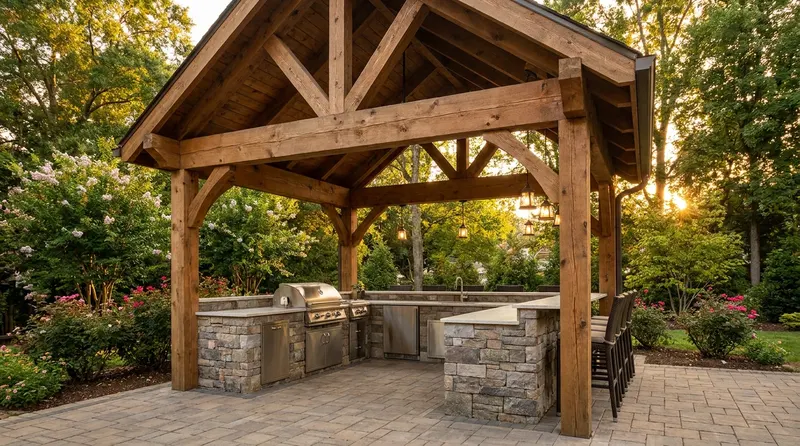
Linear Fire Table Patio Charlotte vs Fire Pit
Opening answer (BLUF)
Choose the fire by how you want people to sit, not by how the flame is boxed. A circular fire pit pulls guests into a ring, everyone facing the same center. A linear fire table patio Charlotte layout stages conversation along a dining or lounge edge, more like a hearth table than a camp circle. NC State Extension treats a fire pit as one kind of garden room, and it asks that the scale of that room follow the activity and the people who use it [1].
Fire as gathering furniture
A fire feature on a Charlotte patio is furniture first. It holds plates, elbows, and a line of sight. It also happens to hold a flame. That is a different question from whether the flame lives in an open pit or in a chimneyed outdoor fireplace. The gathering heart is the shape of the sitting, not the architecture of the enclosure.
NC State describes garden rooms as destinations with a floor, walls, and often a ceiling. The examples include an outdoor dining room, an entertainment space, a kitchen, and a fire pit. Scale is set by function: a room for one reader is smaller than a room for a small group or a large party, and the furniture should match the people who occupy it [1]. Kansas State University’s Johnson County Extension, in 2026 garden-room guidance, calls a patio the family room where friends gather. If the room is for conversation, it needs comfortable places to sit and linger [2].
Our team starts there. We walk the lot, sit where you sit, and ask who arrives on a Friday night. Couples who dine outside want a different geometry than a circle of cousins. The flame is the accent. The seating is the plan.
University of Kentucky landscape-architecture teaching (HO-62) is useful here because it separates two orientations. An inwardly oriented outdoor room has nearly complete enclosure and a strong central focal point. Sitting areas, patios, and similar rooms in the rear yard often want that inward pull. An outwardly oriented room is enhanced by amenities outside the space, such as views and breezes [3]. A circular pit is the inward room. A linear table can keep one side open to the garden, the kitchen, or the house.
The circular fire pit: a ring that pulls people in
A circular fire pit is social geometry in its oldest form. Chairs, a curved seat wall, or a mix of both orbit the flame. There is no head of the table. There is no “other side” of a long edge. Everyone shares the same distance to the fire and the same view of everyone else.
That is the inward room UK Extension describes: enclosure plus a center [3]. NC State’s garden-room language fits it as well. The fire pit is the destination, the ground plane is the floor, and planting or a seat wall becomes the wall that holds the circle [1]. Kansas State notes that garden rooms should feel intimate without feeling closed in [2]. A pit that is too small for eight chairs looks lonely. A pit that is too large for four chairs leaves people shouting across a hole.
On a Charlotte lot this shape belongs on a dedicated conversation court, slightly apart from the dining table, or on a camp-style evening with wood, a spark screen, and a ring of faces. The U.S. Fire Administration’s outdoor-fire messages still apply. Use fire pits outdoors at least 10 feet from the home or anything that can burn, watch children while the pit is in use, and put the fire out before you leave the backyard. For wood-burning fires, a metal screen helps keep sparks from floating out [4].
NFPA’s 2025 fire-pit guidance is more specific about how the ring is staged. Place the pit on a level surface that will not catch fire, such as patio blocks, bricks, or concrete. Keep children and pets at least three feet away. Arrange chairs a safe distance from the pit, and ask adults to model that distance [5]. A chair that is too close is a bad seat. A chair that is too far is a different room.
A circular court also wants a clear way in. If every chair is tight against the next, guests step through the flame to sit down. Leave a gap in the ring, or a path behind the chairs, so the walk to a seat does not cross the fire.
The linear fire table: conversation along an edge
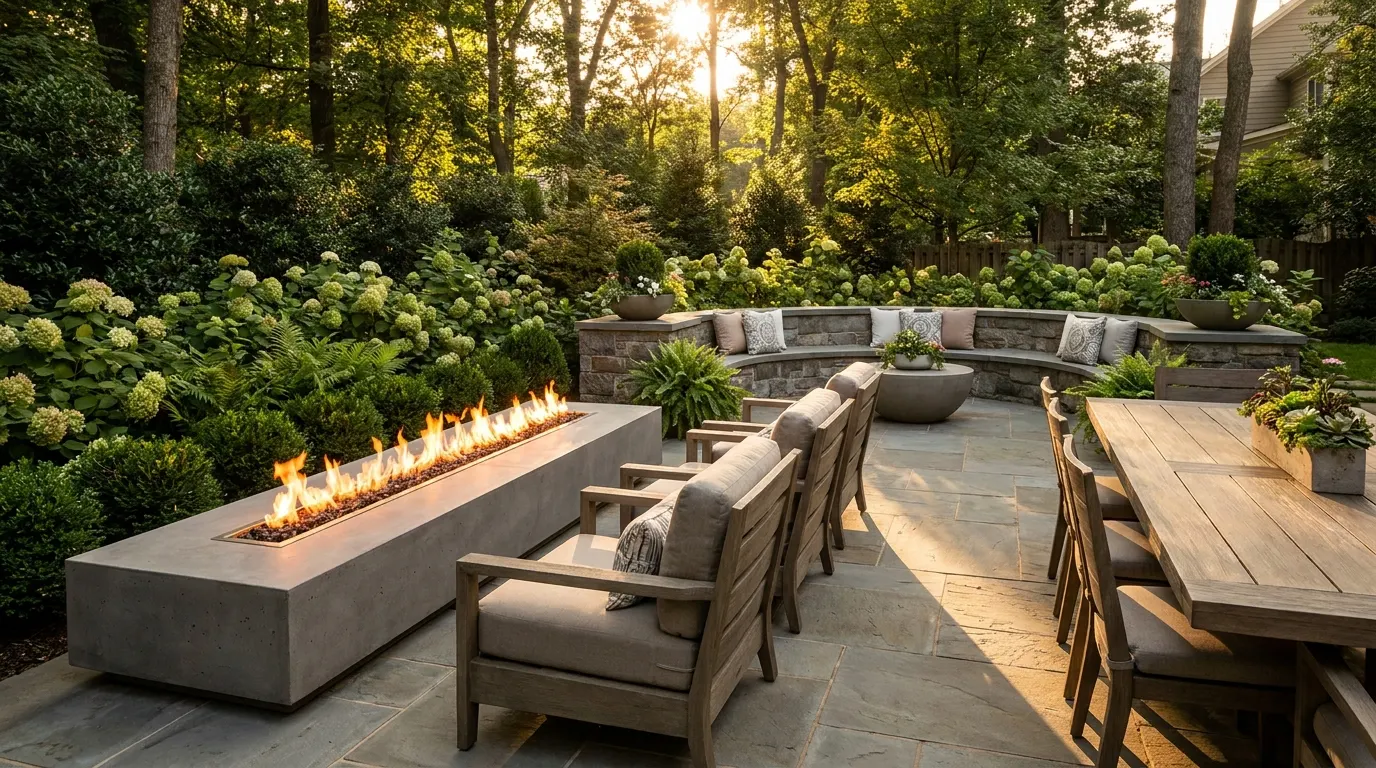
A linear fire table is a different piece of furniture. The flame runs as a ribbon down the center of a tabletop, or as a long trough set into a masonry island. People sit along the long sides, the way they sit at dinner. They can talk across the flame. They can also talk down the line. Drinks and small plates have a place to land. The fire is in the conversation, not in a hole at everyone’s knees.
That is why a linear fire table patio Charlotte plan so often lives on the same pad as dining or lounge seating. It can close one edge of a sectional, stand in for a coffee table, or run parallel to a kitchen counter so the cook still faces the guests. UK Extension’s outwardly oriented room is the better match: the space can open toward a view or the house while the table holds the social line [3]. NC State notes that objects in the landscape should have a direct geometric relationship with the building, and that rectilinear layouts use straight lines while curvilinear layouts use rounded ones [1]. A long fire table is a rectilinear object. It wants a patio that already thinks in edges.
The linear table is also how a modest patio gets a fire without giving up the dining room. A full circle needs diameter. A table needs length. On a Charlotte lot that already holds a grill, a table, and a walk from the back door, length is often the resource you still have.
Gas is the usual fuel for this shape, not because wood is wrong, but because a tabletop is a place for plates. A listed outdoor decorative gas appliance lights, holds a controlled ribbon of flame, and shuts down when the evening is over. ICC-ES product certification for portable outdoor fire pits evaluates samples against ANSI Z21.97/CSA 2.41-2017 (reaffirmed 2022), Outdoor Decorative Gas Appliances, and against the International Fire Code and International Fuel Gas Code [6]. Intertek’s 2020 standards update for the 2017 third edition of that standard added a rain test that runs while the appliance is in operation. If the flame is extinguished, a safety shut-off must stop the flow of unburnt gas [7].
Those are furniture-grade appliances, not a bowl of pooled alcohol on a coffee table. In a December 2024 consumer alert, the U.S. Consumer Product Safety Commission urged people not to buy or use fire pits meant to burn pooled alcohol or other liquid fuel, including products sold as tabletop fire pits and fire pots. Those products violate voluntary standard ASTM F3363-19, written to prevent pool fires and flame jetting [8]. A linear fire table that belongs on a Charlotte patio is a listed gas appliance set into a designed room.
The patio is the floor of the room
Either shape fails if the floor is an afterthought. NFPA asks that a fire pit sit on even ground or a level surface that will not catch fire, such as patio blocks, bricks, or concrete, and that trip hazards come out of the walking path [5]. That is a description of a finished patio, not a bowl dropped on the lawn.
NC State calls the ground plane the floor of the landscape. Patios, terraces, decks, and walkways influence the route people take through the space, and a hardscape walk sends a clear message that this surface is for walking [1]. UK Extension adds that the activity in a room determines the size and material of the floor [3]. Kansas State lists brick, stone, gravel, and concrete among garden-room floors and treats the patio as the family-room floor [2].
Our custom paver patios are that floor. The fire sits in the paving, not on it as a leftover. Joints, banding, and a change of paver size can draw the circle around a pit or the long rectangle around a table. The walk from the back door should arrive at a seat, not at the flame. NFPA also notes that the area should be well-lit when people approach or leave after dark [5]. Lighting belongs to the room, not only to the fire.
Clearances that keep the gathering comfortable
Clearance is how a gathering stays a gathering. It is also how a Charlotte fire feature stays on the right side of the fire marshal.
The U.S. Fire Administration’s public message for fire pits, chimneys, and outdoor fireplaces is to use them outdoors at least 10 feet from the home or anything that can burn [4]. NFPA uses the same 10-foot figure for fire pits and adds that the pit should stay away from siding, decks, railings, vegetation, and out from under eaves or overhanging branches [5]. Those distances shape the patio. A linear table that wants to sit against the house still needs a combustible-free edge. A circular court that wants a tree canopy still needs open sky over the flame.
Inside the City of Charlotte, the Fire Marshal’s Office publishes recreational-fire requirements. Recreational fires (pleasure, ceremonial, cooking, warmth, and similar uses, not trash or yard debris) must be at least 25 feet from structures and other combustible materials, with a fuel area no larger than 3 feet in diameter and 2 feet in height. Portable outdoor fireplaces must be at least 15 feet from structures and other combustibles, used according to the manufacturer’s instructions, and constantly attended, with an extinguisher or garden hose ready [9]. Those rules are written for solid-fuel recreational fires and portable outdoor fireplaces. A listed gas fire table is a different appliance class. It still has to follow its listing, the manufacturer’s clearances, and whatever the local official having jurisdiction requires.
Mecklenburg County’s Code Information and Resource Center, in a residential-questions brochure revised in 2023, is direct about permits. North Carolina Code does not require a building permit for an outdoor wood-burning fireplace as long as the chimney is not within 10 feet of any structures, including the overhang. Permits are not required for wood-burning fire pits. Zoning permits may be required for both. If the fireplace or fire pit is intended to be used with natural gas or propane, a mechanical permit is required [10]. A linear gas table on a Charlotte patio is a mechanical project as well as a furniture project. We design it that way from the first sketch.
NFPA also asks households to check with the local fire department before burning outdoors, never to use gasoline or other flammable liquids on an outdoor fire, and to keep a hose or bucket nearby [5]. Those are the manners of the room. They keep the evening about conversation.
Pairing the fire with how you already host
The right shape often reveals itself in the rooms you already want. A household that cooks outside wants the flame in the same conversation as the grill. A linear table can run beside an outdoor kitchen or bar so the person at the burners is not turned away from the guests. A circular pit usually wants its own court, a few steps off the cooking line, so smoke and seating do not compete with plating.
Seat walls do the same work as extra chairs, with better permanence. A curved wall completes a circular pit. A straight wall can finish one long side of a linear table and still leave an open walk on the other. Our retaining and seating walls are often the walls of the garden room NC State describes: vertical planes that enclose the space and terminate the sightline [1].
Views matter as much as seats. NC State defines focal points as carefully placed objects that direct a person’s line of sight toward a destination [1]. Kansas State recommends walking the yard, framing a good view, and checking the view of the garden room from inside the house [2]. A circular pit is the view. A linear table can share the view. If the best evening light is across the lawn, sit people on the house side of a linear table so they look through the flame to the yard. If the household wants faces more than a vista, build the ring.
This is the work we do on fire pits and fireplaces: not a catalog choice between two products, but a gathering plan drawn onto the patio. Family-owned since 1998, Mr. Outdoor Living® still starts with a no-obligation on-site conversation, free design thinking, and transparent pricing before anyone orders stone. Making Homes More Beautiful® is the finished evening, not a sketch on a screen.
Practical takeaways
- Decide the social geometry first. A circular pit is an inward room with a center. A linear fire table is an edge that hosts dining and lounge conversation.
- Size the room to the people who will actually sit there. NC State sets garden-room scale by function and by group size [1].
- Give the fire a real floor. NFPA wants a level, noncombustible surface such as patio blocks, bricks, or concrete [5].
- Keep the gathering at a comfortable, code-aware distance. USFA’s public message is at least 10 feet from the home or anything that can burn [4]. Charlotte’s Fire Marshal adds 25-foot and 15-foot rules for recreational fires and portable outdoor fireplaces [9].
- Treat a gas linear table as a listed appliance and a permitted mechanical installation. ICC-ES evaluates outdoor decorative gas appliances to ANSI Z21.97/CSA 2.41 [6]. Mecklenburg requires a mechanical permit when natural gas or propane is the fuel [10].
- Leave a way in. A closed ring of chairs forces guests across the flame. A linear table still needs a clear walk behind the seats.
- Skip pooled-alcohol tabletop gadgets. CPSC’s December 2024 alert is unambiguous: those products violate ASTM F3363-19 [8].
How we can help
We design the fire as the gathering heart of the patio, then build the floor, the seating, and the appliance as one Outdoor Living room. If you are weighing a linear fire table against a circular pit, we will sit the layout on your lot, walk the clearances, and show you how guests will actually take a seat. Have more questions or want to get in touch? Contact Mr. Outdoor Living.
Citations
- NC State Extension, "19. Landscape Design" (2022)
- Kansas State University, Johnson County Extension, "Garden Rooms" (2026-05-05)
- University of Kentucky Cooperative Extension, "Landscape Design with Plants: Creating Outdoor Rooms (HO-62)" (2005)
- U.S. Fire Administration, "Outdoor Fire Safety" (2026)
- National Fire Protection Association, "Wildfire Prevention Tips for Fire Pits and Outdoor Fires" (2025-09-10)
- ICC Evaluation Service, "PMG-1718 Portable Outdoor Fire Pits" (2025-10)
- Intertek, "Standards Update Notice: ANSI Z21.97 / CSA 2.41 Outdoor Decorative Gas Appliances, 3rd Edition" (2020-05-28)
- U.S. Consumer Product Safety Commission, "Consumer Alert: Stop Using Alcohol or Other Liquid-Burning Fire Pits That Violate Voluntary Standards..." (2024-12-19)
- Charlotte Fire Department, Fire Marshal’s Office, "Recreational Fires Requirements" (2020-01-01)
- Mecklenburg County Code Information and Resource Center, "Commonly Asked Residential Questions" (rev. 2023-09)
Planning your own outdoor living upgrade? Explore our outdoor living services in Charlotte.