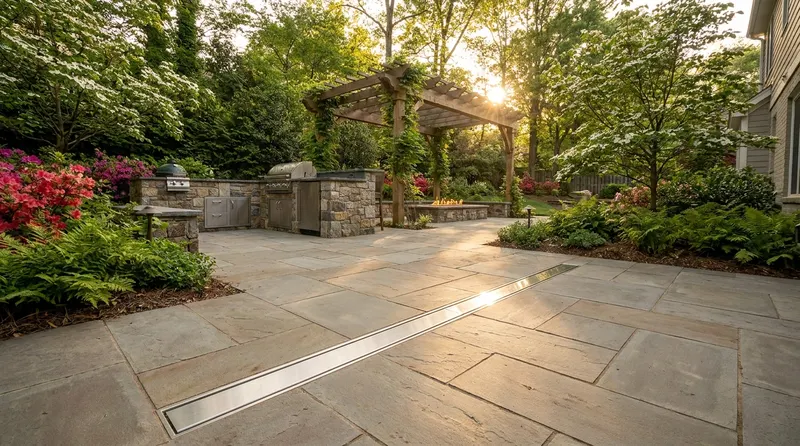
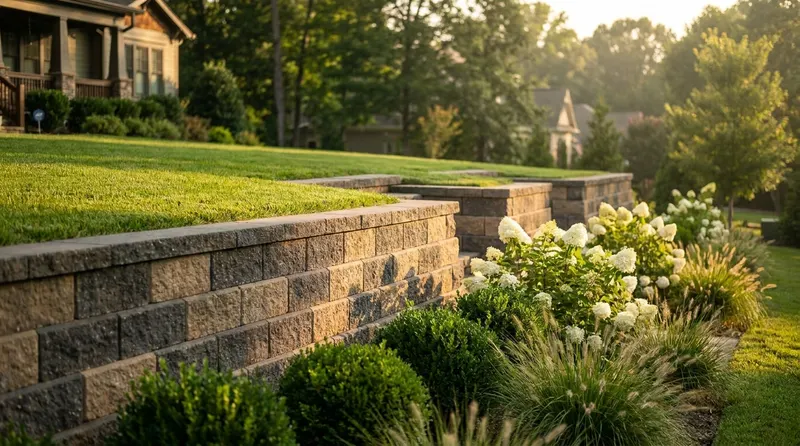
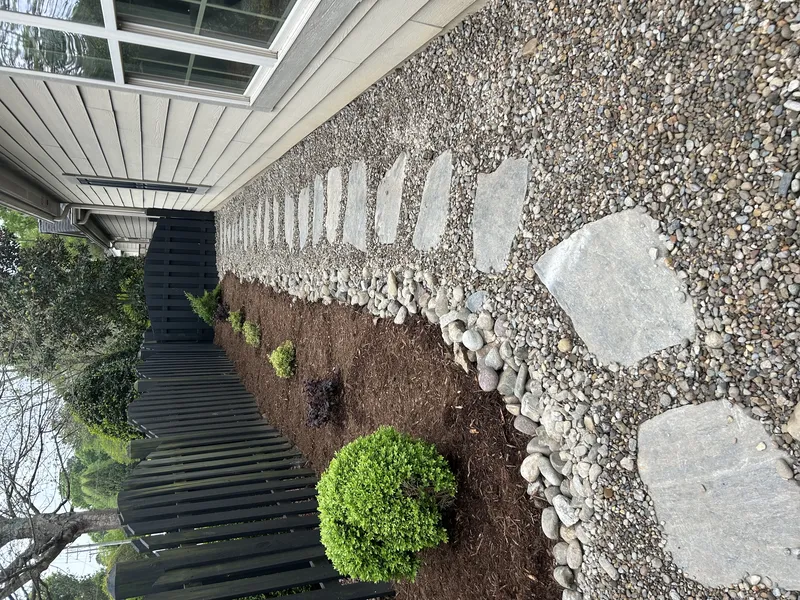
Rain Garden Charlotte vs Dry Creek Beds
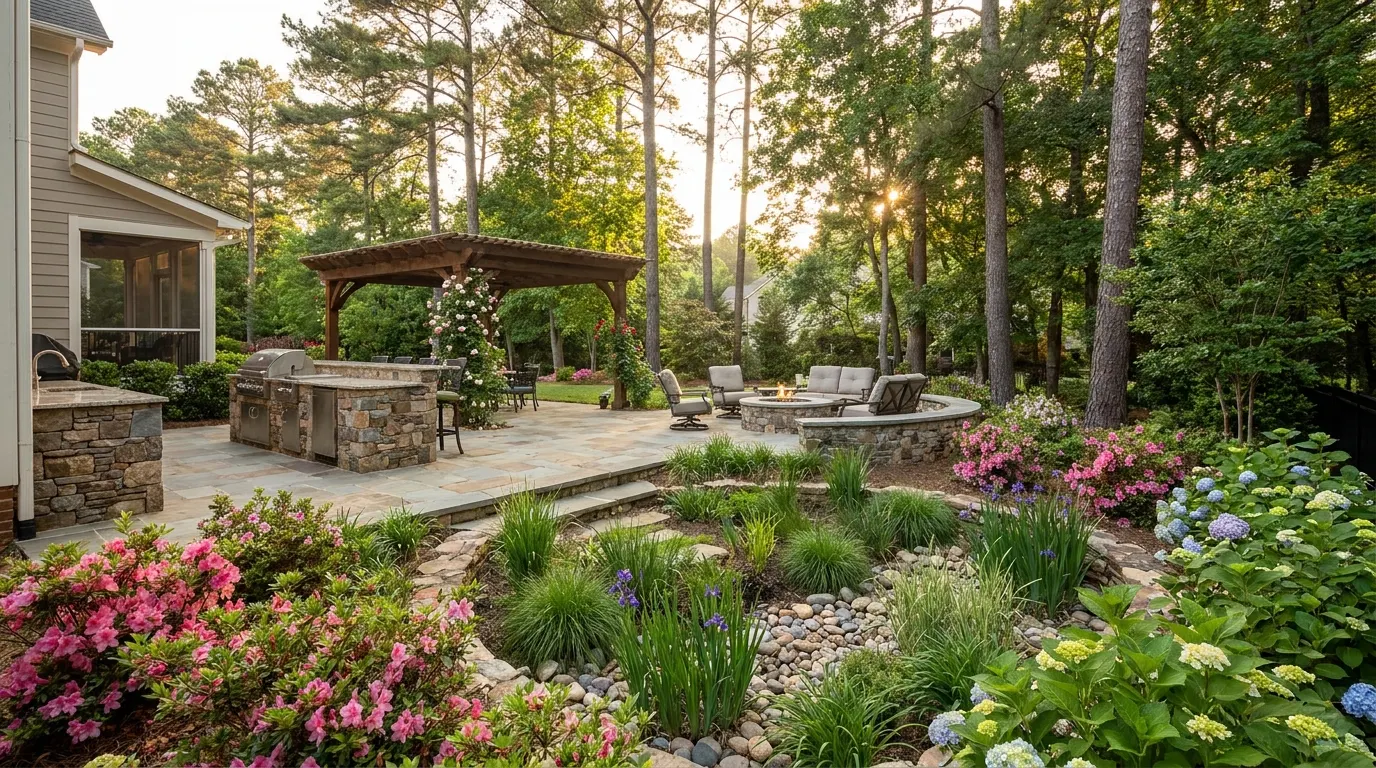
Opening answer (BLUF)
A rain garden Charlotte homeowners can enjoy is a planted, shallow basin that gathers rain from a roof, driveway, or walk and lets it soak into the soil, while a dry creek bed is a composed stone channel that guides that same water through the garden as a designed landscape line. [1][2] Both can look like they belong in a magazine backyard, and both still handle Carolina stormwater with purpose. We treat them as planted sculpture and stone composition, then tune the pair to the way your yard already wants to receive rain.
Rain as a designed material in a Charlotte yard
Charlotte rain is generous, and a well-composed yard can use it. Charlotte-Mecklenburg Storm Water Services describes a stormwater-friendly yard, sometimes called a green yard, as a landscape designed to absorb rainwater, reduce runoff, and keep nearby streams, rivers, and lakes cleaner. [3] Even a modest change, such as adding a rain garden or exchanging a strip of lawn for native shrubs, is framed as a real contribution to that kind of yard. [3]
Rain that leaves a roof or patio is simply water looking for a beautiful place to land. Clemson Extension’s Carolina Yards program notes that a 1,000 square foot roof generates more than 600 gallons of runoff in a 1-inch storm, which is a surprising amount of water to compose with. [4] Directing downspouts toward a planted basin or a stone channel turns that volume into a seasonal show: wet, then dry, then planted again. Native plants help that composition work. Charlotte-Mecklenburg Storm Water Services notes that native plants have deep root systems that improve infiltration, and a 2020 Clemson Extension factsheet adds that native perennials, grasses, and shrubs typically send roots deeper than traditional turf. [3][5]
The rain garden as planted sculpture
A rain garden is a depressed area in the landscape that collects rain from a roof, driveway, or street and allows it to soak into the ground. [1] The U.S. Environmental Protection Agency describes rain gardens as small, shallow, sunken planting areas that filter stormwater through a mix of soil, sand, or gravel. [2] More engineered versions with underdrains and amended soils are often called bioretention, though many municipalities use the friendlier rain garden name for both. [1][2]
N.C. Cooperative Extension describes the same idea in local terms: attractively landscaped shallow depressions designed to capture rain so plants and soil can do what nature already knows how to do. [6] Clemson’s Carolina Rain Garden Initiative calls it a landscaped depression that gives runoff from rooftops, driveways, and compacted lawns a chance to infiltrate, while beautifying the home landscape and creating wildlife habitat. [7] Planted with grasses and flowering perennials, a rain garden can also offer food and shelter for butterflies, songbirds, and other wildlife. [1]
The name is a little misleading, and that is part of the charm. A 2020 Clemson Extension factsheet notes that a rain garden is more often dry than wet, and that a well-designed basin should drain in under 72 hours. [5] Virginia Cooperative Extension offers a useful picture: think of a puddle with plants. [8] After rain, the basin may hold a shallow sheet of water. Then the water sinks, the mulch darkens, and the planting reads again as a garden bed.
Shape is a design choice. Rain gardens can be kidney-shaped, oval, or a long crescent that echoes a patio edge. Virginia Cooperative Extension recommends a finished depth of about 6 to 8 inches below the surrounding soil, with plants chosen for flowers, berries, bark, or foliage that hold interest through the year. [8] N.C. Cooperative Extension’s 2024 plant list is built for that wet-then-dry rhythm and includes Piedmont-friendly trees such as river birch and red maple, shrubs such as Virginia sweetspire, inkberry, winterberry, and buttonbush, and herbaceous plants such as blue flag iris and cardinal flower. [9]
A rain garden also has a quiet scale rule. Virginia Cooperative Extension suggests sizing the basin by dividing the square footage of the hard surfaces that drain to it by 20, then allowing the garden to be larger than that minimum if the composition wants more presence. [8] We use that math as a starting point, then adjust for the view from the kitchen window and the walk from the patio.
The dry creek bed as stone composition
A dry creek bed is the stone counterpart to that planted basin. Oregon State University Extension lists dry creek beds, alongside bioswales and permeable patio surfaces, as a way to guide stormwater through a designed landscape. [10] The same guide suggests letting a path meander so it reads like a creek bed, which is a useful reminder that the feature can be both circulation and sculpture. [10]
Clemson Extension describes the close cousin of a dry creek, the vegetated bioswale, as a planted channel that carries water from one place to another, unlike a rain garden, which holds water in a basin. [11] Vegetated swales can be planted with ornamental grasses, shrubs, and perennials. Mulch or stone protects the soil, and larger stone can break up concentrated flow and slow the water. [11] Most of these channels are designed to be dry except just after rain, which is exactly the mood a dry creek should have: a composed river of stone that wakes up when the sky opens. [11]
The U.S. Environmental Protection Agency groups bioswales with rain gardens as green infrastructure. Bioswales are open channels that use vegetation or mulch to slow, filter, and treat stormwater as it moves through a shallow trench. [2] That linear quality is why a dry creek bed sits so well next to a patio or along a side yard. River cobble, a few standing boulders, and planted pockets along the banks can look as considered as a dining terrace.
University of Florida IFAS shows how the two ideas can share one composition. A campus rain garden there includes a dry river bed coursing through the planting, so the stone gathers water while the plants hold the banks. [12] Oregon State University Extension notes that some rain gardens are designed with a dry creek-bed look and plants around the edges. [13] We like that pairing when a yard wants both a planted moment and a stone ribbon that leads the eye.
Composition matters more than quantity of rock. Larger stones belong where water first arrives, under a downspout or at a bend, because that is where the current is strongest. [11] Finer gravel and cobble fill the channel, and planting pockets of sweetspire, sedge, or iris along the banks keep the stone from looking bare between storms.
Choosing one, or composing both
A rain garden is the right first move when you want a planted focal point that holds water, then gives it back to the soil. It belongs between the source of runoff (a roof plane, a driveway, a patio) and the place that water is already heading. [6][8] Virginia Cooperative Extension recommends keeping the basin at least 10 feet from a building foundation, and UF/IFAS offers the same setback so water has room to soak without lingering at the house. [8][12] Partial to full sun helps the planting bloom, and N.C. Cooperative Extension notes that moisture-tolerant natives also raise the habitat value of the yard. [6]
A dry creek bed is the right first move when the water wants to travel. Side yards, the long edge of a patio, and the line from a downspout to a distant planting bed all benefit from a stone channel that looks finished on dry days. Clemson Extension notes that well-designed swales can be attractive landscape areas in their own right, adding texture, color, and usefulness. [11] They also work as part of a series of practices, a treatment train, rather than as a single isolated object. [11]
Many Charlotte yards want both. A short stone run can deliver roof water into a planted rain garden. The garden holds the first flush, the plants take a drink, and a rock-lined weir lets extra water continue downstream in a graceful line. N.C. Cooperative Extension places a rain garden between the source of runoff and its destination, which is the same logic we use when we sketch a creek that arrives, pauses, and moves on. [6] Clemson Extension describes a similar sequence when overflow from a rain barrel or cistern is directed toward a rain garden. [5]
The choice is visual as much as hydrologic. If you want color and a bed that changes with the seasons, start with a rain garden. If you want a line that reads even in January, start with a dry creek. If you want a yard that feels composed in every weather, we often draw both.
Plants that give a Piedmont rain garden year-round character
Plant selection is where a rain garden Charlotte project becomes a garden, not a basin. Because the center stays wet longer than the rim, we plant in zones. Virginia Cooperative Extension places the most moisture-tolerant species in the lowest area, then steps to shrubs and perennials that like shorter wet periods, then to plants that live on the drier shoulder. [8] UF/IFAS makes the same point in simpler language: choose plants that tolerate wet feet and also the dry weeks between Carolina storms. [12]
N.C. Cooperative Extension’s 2024 list is a strong Piedmont starting palette. River birch and red maple give height and winter bark. Virginia sweetspire, inkberry, winterberry, wax myrtle, sweet pepperbush, and buttonbush give structure and bloom. Blue flag iris and cardinal flower give the color that people remember from the sidewalk. [9] The Extension Gardener Plant Toolbox can refine that list for Piedmont conditions, pollinators, bloom time, and even deer resistance. [9]
That 2020 Clemson factsheet also notes that a mature tree can handle up to hundreds of gallons of water in a single rain event, which is why a carefully placed river birch or red maple can be the quiet workhorse of a larger rain garden. [5] We still keep trees in scale with the basin. Virginia Cooperative Extension recommends trees only when the garden is large enough, and treats them as individual specimens rather than a grove. [8]
Texture does as much work as flower color. Fine grasses against river stone, glossy inkberry against pale gravel, and winterberry against evergreen yaupon keep the composition interesting after the last cardinal flower fades. [9]
Our plantings work follows the same idea across the rest of the yard, so the rain garden shares a palette with the beds beside the patio. When we design drainage as a visible landscape feature, the plants and the stone are part of the same drawing.
How we place these features with patios and outdoor living
A rain garden or dry creek earns its keep when it is part of how you live outside. We often set the planted basin where it can be seen from the kitchen or the dining terrace, so the day after a storm you notice the sheen of water and the way iris leaves stand in it. A dry creek can leave a downspout, slip beside a patio, and arrive at a planting bed as if the stone had always been there.
These features also sit comfortably next to other water moments. A recirculating fountain or a small basin can share a patio with a rain garden without competing, because one is theatrical and the other is seasonal. If you already love the sound of moving water, our water features and a rain garden can occupy different parts of the same composition: one for evening gatherings, one for the morning after rain.
Placement still follows a few calm rules. Keep the basin downslope of the house and at least 10 feet from the foundation. [8][12] Stay clear of septic fields and wells. [12] Watch a real storm before we stake the outline, so the garden sits on the path the water already prefers. [6][8] Size the rain garden to the roof and driveway that will feed it, then give extra water a designed exit rather than an afterthought. [8]
Clemson Extension’s 2020 guidance notes that a combination of practices usually gives the best result, and that is how we draw a yard: permeable walks, planted beds, a rain garden, and a stone channel working together. [5] A mature tree, a mulched bed, and a composed creek can all share the same afternoon of rain. The goal is a landscape that looks finished on a dry Tuesday and still feels generous when the clouds open.
Practical takeaways
- A rain garden is a planted, shallow basin that collects roof and driveway rain and lets it soak in. It is meant to be dry most of the time and to look like a garden, not a pond. [1][5]
- A dry creek bed is a stone channel that guides water through the yard. It is the linear cousin of a bioswale and should look composed even when no water is moving. [2][10][11]
- Many Charlotte yards want both: a short stone run that delivers water into a planted rain garden, then a designed overflow that continues the line. [6][11]
- Size a rain garden from the hard surfaces that drain to it. Virginia Cooperative Extension’s homeowner rule is to divide that square footage by 20, then refine the shape for the view. [8]
- Keep the basin at least 10 feet from the house, and plant the wettest species in the lowest zone. [8][12]
- Build the Piedmont palette from plants that accept wet-then-dry life, such as river birch, Virginia sweetspire, inkberry, winterberry, blue flag iris, and cardinal flower. [9]
- Use larger stone where water first arrives, then finer cobble in the channel, and tuck plants along the banks so the creek reads as a garden line. [11]
- Charlotte-Mecklenburg Storm Water Services treats a rain garden as one of the small, beautiful moves that make a green yard. Native plants do the quiet work of soaking rain and feeding pollinators. [3]
How we can help
We design rain gardens and dry creek beds the same way we design the rest of a Charlotte outdoor living plan: as finished landscape, with free design conversations and transparent pricing. Our team walks the yard in the weather it actually has, then draws a planted basin, a stone channel, or both so the rain has a beautiful place to go. Making Homes More Beautiful® includes the ground after a storm, not only the patio on a clear evening.
Have more questions or want to get in touch? https://mroutdoorliving.com/contact/
Citations
- U.S. Environmental Protection Agency, "Soak Up the Rain: Rain Gardens" (2026)
- U.S. Environmental Protection Agency, "Types of Green Infrastructure" (2026)
- City of Charlotte / Charlotte-Mecklenburg Storm Water Services, "Create a Stormwater-Friendly Yard" (2025)
- Clemson Cooperative Extension, Carolina Yards, "Rain as a Resource" (n.d.)
- Clemson Cooperative Extension Home & Garden Information Center, "Water Management In The Home Landscape" (2020)
- N.C. Cooperative Extension, Chatham County Center, "Rain Gardens" (n.d.)
- Clemson Cooperative Extension, "Carolina Rain Garden Initiative" (n.d.)
- Virginia Cooperative Extension, "Stormwater Management for Homeowners Fact Sheet 5: Rain Gardens" (2024)
- NC State Extension Gardener, "Rain Garden Plant List" (2024)
- Oregon State University Extension Service, "Waterwise gardening in Central Oregon" (2020, reviewed 2025)
- Clemson Cooperative Extension Home & Garden Information Center, "An Introduction to Bioswales" (2015)
- University of Florida IFAS Gardening Solutions, "Rain Gardens" (n.d.)
- Oregon State University Extension Service, "Rain Gardens: Low-impact development fact sheet" (2018, reviewed 2022)
Planning your own outdoor living upgrade? Explore our outdoor living services in Charlotte.