Layered Landscape Lighting Charlotte After Dark
Opening answer (BLUF)
Night lighting is a design language. Soft layered path and ambient light invites lingering on the patio, while bold feature spotlights sculpt trees, walls, and water into clear evening focal points. The most energy-effective designs balance three lighting layers (ambient, task, and accent), then let you dial the mood with warmth, aiming, and controls.[1] For Charlotte homeowners, the decision is not which product catalog looks busier. It is which after-dark atmosphere you want to live in.
Night light as a design decision
When we plan outdoor living for Charlotte and nearby communities, we treat lighting the way we treat plant beds or paver patterns: as a composition with hierarchy, rhythm, and rest. Good outdoor light reveals form and texture. It does not simply make a yard bright.
Designers and facilities standards groups describe residential and architectural lighting as a balance of three layers. Ambient light sets the base glow for orientation. Task light supports specific moments such as steps, entries, and cooking counters. Accent light creates drama by highlighting the features you chose on purpose: a specimen canopy, a stone face, a waterfall edge.[1] That three-layer idea is the backbone of layered landscape lighting Charlotte families ask us about when they want evenings outdoors to feel intentional rather than improvised.
Once you see the backyard as a night composition, the choice between soft layering and bold spotlighting becomes clearer. Layering builds a place to stay. Spotlights build a place to look. Many of the most memorable yards combine both, with one approach leading the mood and the other supporting it.
Soft layered path and ambient light: the invitation to linger
Layered path and ambient light is the hospitality side of outdoor lighting. Path lights, low-output area fixtures, step lights, and discreet cap lights under seating walls or outdoor kitchen counters create a gentle field of light. Guests can walk, sit, and converse without squinting into a glare source. The space reads as open and welcoming after sunset.
Ambient and path layers work best when they stay quiet. Shielded fixtures keep the source of light out of direct view so the glow falls on surfaces, not into eyes. Professional guidance on responsible outdoor lighting emphasizes light that is useful, carefully aimed, no brighter than needed, controlled by time or need, and warmer in color when possible.[2] Those principles fit a linger-first patio perfectly. You want enough light to feel comfortable crossing the pavers with a tray of glasses, and not so much that the conversation feels staged under a parking-lot wash.
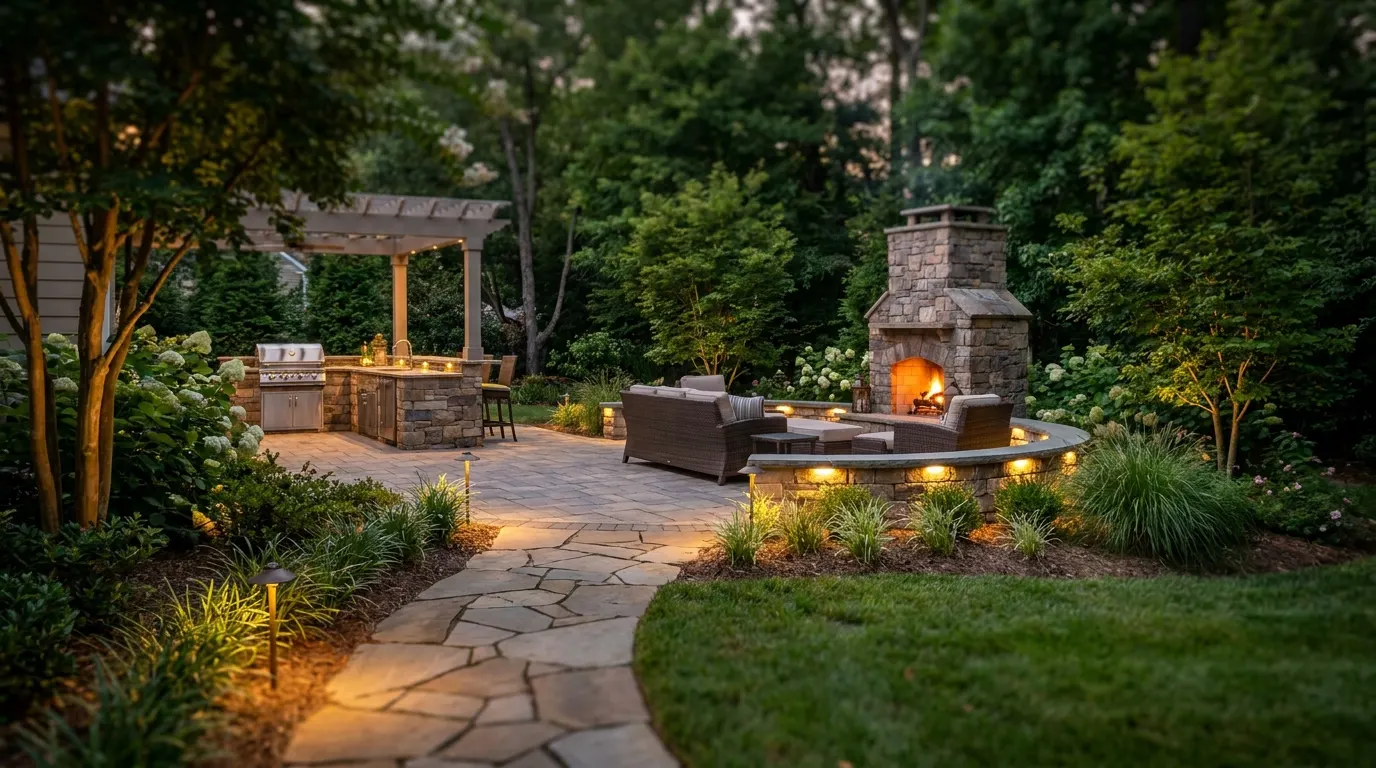
In a Charlotte backyard, soft layering often pairs with hardscape we already love in daylight: a Belgard-style patio, curved walk edges, retaining and seating walls, and planting that softens the perimeter. Cap lights under wall caps and outdoor kitchen counters add a low, continuous line of light that flatters stone and wood tones. Path fixtures staggered along walkways create rhythm without the harsh “runway” look of perfectly mirrored rows. Small pools of light, with intentional darker gaps between them, give the eye places to rest and make the bright moments more enjoyable.
This style of layered landscape lighting Charlotte homeowners choose when they picture long dinners, kids playing near the edge of the patio while adults talk, or quiet evenings with the fire feature on low. The payoff is time. Soft layers extend the hours you want to use the yard without asking the space to perform like a stage set.
Bold feature spotlights: sculpting trees, walls, and water
Feature spotlights and uplights are the drama side of the language. Narrower beams pick out a single tree trunk and canopy, graze a textured retaining wall, or skim across water so movement and reflection catch the eye. In residential craft practice, accent light is often the smallest fixture count in a plan, yet it delivers the strongest visual hierarchy when the other layers stay quieter.
Uplighting a mature oak or crape myrtle turns the canopy into architecture after dark. Grazing a stacked stone or block wall pulls out shadow lines that disappear under flat flood light. Water features reward careful aiming: a waterfall face, a basin edge, or a rock outcrop can read as a living sculpture when light meets moving water at the right angle. Our outdoor lighting work often uses LED uplights on specimen trees, boulders, and home facades, with path lights and cap lights filling the softer roles around those stars.
Spotlights work best when they are selective. Lighting every plant with equal intensity flattens the yard. Choosing one or two heroes per view corridor creates depth: bright form in the mid-ground, softer ambient nearer the seating, and a darker frame beyond. Responsible outdoor guidance also notes that light aimed carefully at the target, rather than spilled upward and outward, improves the quality of what you see while limiting light that does not serve the design.[2]
Choose a spotlight-led approach when you want the evening view from the kitchen window or patio seating to feel like a composed landscape painting. Feature-first lighting celebrates the investments you already made in plantings, walls, and water. It is aspirational staging: the yard as a night gallery you walk through on the way to dinner.
Choosing the evening atmosphere you want
Most Charlotte properties land somewhere between pure hospitality lighting and pure feature drama. The useful design question is which atmosphere leads.
If your primary dream is lingering, lead with ambient and path layers. Light the routes between house, patio, outdoor kitchen, and seating first. Keep overall levels moderate. Use accent sparingly as jewelry: one tree, one wall plane, or a water edge that rewards a glance without competing with faces across the table.
If your primary dream is a sculpted night view, lead with accents. Place spotlights and uplights on the features that already make the property special. Then add just enough path and step light so movement feels easy. The ambient layer supports the show rather than washing it out. In practice, too much ambient light can diminish the contrast that makes accents powerful, which is why balance between layers matters for energy-effective design as well as aesthetics.
A third option many homeowners enjoy is zoning by mood. Front entry and walkways stay softly guided. The patio living zone stays warm and social. A garden or water corner becomes the feature moment. Low-voltage LED systems with timers or photocells make that zoning practical, so different areas can hold different intensities without constant fiddling at a switch.
Color temperature is part of atmosphere. Warm white light (around 2,700K on the correlated color temperature scale) is the residential standard people associate with inviting interior and outdoor evenings, while cooler whites read brighter and more institutional.[3] Warm LEDs flatter plant material, pavers, and wood. They also align with outdoor guidance that prefers warmer colors where possible.[2]
LED craft, durability, and controls that keep the design living
Modern residential landscape lighting is almost always LED for good reason. The U.S. Department of Energy notes that LEDs consume about 75 percent less energy and last up to 25 to 50 times longer than incandescent bulbs.[4] ENERGY STAR guidance similarly highlights that LEDs can provide the same brightness as traditional bulbs while using far less energy and lasting many times longer, with much less waste heat.[5] University extension materials also point out that LEDs are directional light sources, which means they can put light where the design needs it rather than scattering it in every direction the way older bulbs often did.[3]
Outdoor fixtures face weather, vibration, and seasonal temperature swings. LED products built for exterior use handle those conditions well and support frequent on/off cycling without the life penalties common to older lamp types.[3][6] That durability matters when lights run every evening across Charlotte’s long outdoor season.
Controls complete the design. Timers, photocells, and motion-based strategies help light appear when it is useful and rest when it is not, which is a core idea in responsible outdoor lighting practice.[2] For homeowners, automation means the layered plan you approved looks correct night after night without a nightly ritual at the panel. It also means you can keep overall light levels thoughtfully moderate while still having the space ready for guests.
Market data shows outdoor applications have already embraced LEDs more than many indoor uses, with outdoor LED penetration reported higher than indoor penetration in DOE adoption analysis, and outdoor applications contributing a large share of realized LED energy savings.[7] For a homeowner, the practical takeaway is simple: efficient fixtures and good controls make a generous design more comfortable to live with over years of evenings.
How layered landscape lighting Charlotte yards can mix both languages
A complete plan for layered landscape lighting Charlotte clients often reads like a short story of the property after dark.
Near the house, soft ambient and path light welcomes people onto the patio. Cap lights under the outdoor kitchen or seating wall keep faces and serving surfaces gently lit. Step lights mark grade changes so movement stays easy. Mid-yard, a spotlight lifts a specimen tree that anchors the view from the main seating group. At the water feature, a focused beam finds the fall or basin edge so sound and light meet. Farther out, plant beds stay quieter so the eye has a dark frame and the lit moments feel richer.
We design those systems as part of outdoor living, not as an afterthought. The same team that places patios, plantings, walls, and water can place light so the night composition matches the daytime one. That continuity is what makes the backyard feel finished when the sun drops behind the trees.
Practical takeaways
- Decide the lead mood first: lingering hospitality (soft path and ambient layers) or sculpted focal drama (feature spotlights and uplights).
- Use the three-layer model: ambient for orientation, task for steps and work surfaces, accent for trees, walls, and water.[1]
- Keep light useful, aimed, moderate in brightness, controlled by schedule or need, and warm in color when possible.[2]
- Prefer warm white LEDs near about 2,700K so plantings, stone, and wood feel inviting rather than clinical.[2][3]
- Choose LED fixtures built for outdoor duty; LEDs use substantially less energy than older lamp types and last far longer.[4][5]
- Let darker gaps remain. Even spacing that floods every surface removes depth. Hierarchy creates beauty.
- Automate with timers or photocells so the design you love is the design you actually get every evening.[2]
- Coordinate lighting with hardscape and plant features so night and day share the same story.
How we can help
We design and install outdoor LED lighting for Charlotte-area homes as part of complete outdoor living, including path lights, uplights, cap lights, and water-feature lighting that stages the evening atmosphere you want. If you are ready to plan layered landscape lighting for your patio, plantings, walls, or water feature, explore our outdoor lighting services or request a price. We will walk the property with you, talk through soft layering versus bold feature moments, and build a plan that feels warm, intentional, and ready for the next long Carolina evening outdoors.
Citations
- U.S. National Park Service - "Lighting Standards" (2026)
- U.S. Department of Energy - "Next Steps: Five Principles for Responsible Outdoor Lighting" (via DOE SSL / IES-IDA Five Principles)
- University of Florida IFAS Extension - "Energy Efficient Homes: Introduction to LED Lighting" (FY1049)
- U.S. Department of Energy - "Addressing Misinformation on DOE Appliance Standards" (2023-05-05)
- ENERGY STAR - "Upgrade Your Lighting"
- Indiana University of Pennsylvania - "LED Lighting Benefits"
- U.S. Department of Energy - "LED Adoption Report" (2020 report summary)
Planning your own outdoor living upgrade? Explore our outdoor living services in Charlotte.